
Solar system on the balcony: Is this mini power plant worth it?
Advertisement
The Solar panels on the balcony It's conquering German households, but is it really a worthwhile investment?
In times of rising electricity prices and the drive for sustainability, balcony power plants are gaining in popularity.
They promise on-site electricity production, cost savings and a contribution to the energy transition, without requiring much space.
But does the mini power plant live up to its promises? This article examines the advantages, challenges, and costs of a Solar panels on the balcony, provides up-to-date data and practical tips to help you make your decision.
Is the step towards your own solar energy as easy as it sounds? Let's dive in!
The energy transition is on everyone's lips, and more and more people are looking for ways to actively participate in it.
One Solar panels on the balcony It offers a low-threshold way to use renewable energies directly in everyday life.
Especially in urban areas where roof space is often lacking, these compact systems are a clever alternative.
However, there are several things to consider, including legal regulations, technical requirements, and financial considerations.
This article analyzes whether the investment is worthwhile and provides you with a sound basis for your decision.
What is a balcony solar system?
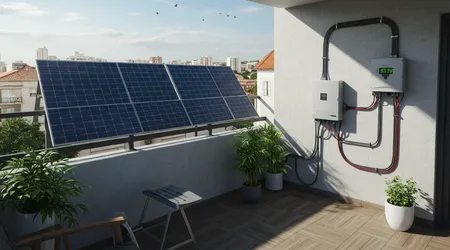
One Solar panels on the balcony It consists of one to four solar modules, an inverter and a connection to the power grid.
It generates electricity directly for the household. Typically, such systems deliver 300 to 800 watts of power, depending on the number of modules and the amount of sunlight.
Installation is simple, often advertised as "plug-and-play". This allows tenants and owners to become more independent from electricity providers.
The technology is mature, and the systems are easy for laypeople to use. Modules are attached to the balcony railing or the wall.
++ What does energy efficiency class A+++ really mean?
The inverter converts direct current (DC) into alternating current (AC), which can be used for household appliances. Since 2024, inverters with a power output of up to 800 watts are permitted in Germany without a permit, which simplifies their use.
The purchase price ranges from 400 to 1,200 euros, depending on quality and performance. Subsidy programs, such as those in Bavaria, partially reduce the costs.
However, the savings depend on factors such as solar radiation and electricity consumption. Accurate calculation is crucial.
Economic efficiency: Does the investment pay off?
The question of the economic viability of a Solar panels on the balcony This is crucial. With electricity prices of around 40 cents/kWh (as of 2025), savings can be attractive.
A 600-watt system generates approximately 500–600 kWh annually, saving 200–240 euros. Amortization often takes 5–7 years.
According to a study by the Fraunhofer Institute (2023), balcony power plants can cover 20–30 % of the electricity needs of a single household.
However, solar radiation varies considerably from region to region. Yields are higher in southern Germany than in the north. A site analysis is therefore essential.
See more: Energy certificate: obligations, costs and tips for landlords
For example: Anna from Munich saves 220 euros annually with her 600-watt system. After 6 years, the system has paid for itself.
However, the return would be lower in Hamburg. Additionally, fluctuations in electricity prices affect profitability. In the long run, the investment usually pays off.
The following table shows a sample calculation for a 600-watt system:
| component | Costs/Savings |
|---|---|
| Acquisition costs | 600 € |
| Annual yield (kWh) | 600 kWh |
| Savings per year | €240 (at 40 cents/kWh) |
| Payback period | 2.5–3 years |
Regional subsidies, such as those in Berlin (up to €500 grant), shorten the amortization period. However, hidden costs, such as maintenance or spare parts, should be considered. A long-term perspective is crucial.
Technical and legal framework
The installation of a Solar panels on the balcony It's technically straightforward, but there are legal hurdles. Since 2024, registration with the network operator has been simplified.
Landlord permission is often required, especially in rented apartments. Connection is usually made via a standard wall socket (Schuko socket).
Safety standards are strict. The inverter must comply with VDE standards, and the installation may only be inspected by qualified professionals.
An incorrect connection can cause problems with the power grid. Check with your network operator beforehand.
See also: How to save electricity in everyday life – without changing your lifestyle
Tenants like Lukas from Berlin often had to fight to convince landlords. Clear arguments, such as cost savings and environmental protection, help.
Furthermore, the federal government promotes balcony power plants through simplified bureaucracy. Nevertheless, regulations vary from state to state.
Environmental benefit: A step towards the energy transition?
One Solar panels on the balcony It reduces the carbon footprint. Approximately 400 g of CO₂ are saved per kWh of solar power compared to coal. A 600-watt system saves about 240 kg of CO₂ annually. That's a small but noticeable contribution.
Let's compare it to a tree: A balcony power plant is roughly equivalent to the CO₂ sequestration of 10 young trees. However, the production of the modules also causes emissions.
Sustainability only becomes apparent after several years of use. Nevertheless, environmental considerations are a strong incentive.
Critics argue that the effect is small compared to large solar parks. However, the combined effect of many small installations makes a difference.
In Germany, over 270,000 balcony power plants were installed in 2023. Together, they contribute to the energy transition.
Practical tips for installation
Plan your Solar panels on the balcony Carefully. Check the solar radiation using tools such as the solar cadastre.
South-facing balconies without shade are ideal. Choose certified modules and inverters from brands like Hoymiles.
Installation is often DIY-friendly, but safety precautions are crucial. Use brackets that are suitable for your railing.
A professional inspection after installation ensures proper functioning. Regular cleaning of the modules increases yield.
Don't forget to register with the grid operator. Failure to do so could result in fines. Feed-in tariffs (approx. 8 cents/kWh) can also be worthwhile if you feed surplus electricity into the grid. Inquire about local subsidies.
Challenges and limitations
Despite the advantages, there are hurdles. The returns of a Solar panels on the balcony They are weather-dependent. Cloudy days or shade reduce efficiency. In cities, balconies are often poorly oriented. A north-facing balcony is usually unprofitable.
The lifespan of the modules (approx. 20 years) and the inverter (approx. 10 years) also limits their use. Spare parts cost money, and disposal is environmentally damaging. Tenants also face the hurdle of convincing their landlords.
Another problem is storage. Without battery storage, excess electricity is often fed unused into the grid. Battery storage systems are expensive (starting at €1,000) and increase the amortization period. Realistic expectations are important.
Comparison with alternatives
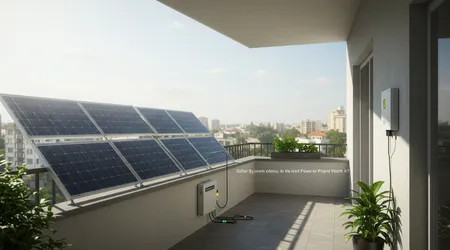
Compared to rooftop solar systems, balcony power plants are cheaper but less powerful. A rooftop system often generates ten times more electricity but is more expensive (starting at €10,000). For renters, the Solar panels on the balcony often the only option.
Energy-saving measures, such as LED lamps or smart thermostats, are also effective, but do not provide their own electricity.
Switching electricity tariffs might be cheaper in the short term, but solar panels offer long-term independence. Combining several measures is ideal.
For example: The Meier family saves €100 annually with LED lamps and €200 with a balcony power plant. Combining both maximizes the savings.
But the willingness to invest is the deciding factor. Balcony power plants score points for their simplicity and flexibility.
Future prospects: Where is the trend heading?
Demand for balcony power plants is growing. In 2023, Germany recorded an increase of 85 million cubic meters in new PV installations (ZVEH). Simplified regulations and falling module costs are driving this trend. Millions of households could be equipped by 2030.
Technological advances, such as more efficient modules or cheaper storage solutions, are making balcony power plants more attractive.
Tenant initiatives for community solar projects are also on the rise. Politicians are supporting this through subsidies and reduced bureaucracy.
However, grid stability remains a challenge. Many small power plants can put a strain on the electricity grid.
Experts are calling for intelligent control systems to prevent this. The future of Solar panels on the balcony It is promising, but not without hurdles.
Conclusion: Is a balcony solar system worthwhile?
One Solar panels on the balcony It is a worthwhile investment for many households. It saves costs, reduces CO₂ emissions, and promotes the energy transition.
However, the yield depends on location, orientation, and consumption. Tenants must convince landlords, and amortization takes several years. With careful planning and realistic expectations, a mini power plant is a smart option.
The combination of environmental awareness and financial advantages makes balcony power plants attractive.
They're not a panacea, but a step in the right direction. Get informed, assess your situation, and start your own small energy revolution. What's holding you back?
Frequently Asked Questions (FAQ)
1. Do I need a permit for a balcony power plant?
Yes, landlord approval and registration with the network operator are required. Registration has been simplified since 2024.
2. How much electricity does a balcony power plant save?
A 600-watt system saves approximately €200–240 annually, depending on electricity price and yield.