
Why standby power consumption is still underestimated
Advertisement
Standby power consumption is an often overlooked energy guzzler that will still contribute massively to unnecessary electricity waste in modern households and offices even in 2026.
Many people underestimate this silent cost factor, even though it adds up to a considerable sum on the electricity bill over the course of the year.
A more conscious approach to electrical devices could significantly reduce energy consumption.
It is a technological illusion that switched-off devices are truly at rest, because many of them are constantly waiting in the background for a signal.
This hidden energy absorption quickly adds up to a considerable total volume.
In today's article, we examine why this area remains so critical for your energy balance and how you can actively counteract it.
- Why invisible flows strain your budget
- Technical background of energy absorption
- Practical solutions for reducing consumption
Why is standby power consumption underestimated?
The creeping danger in the home
The standby power consumption It seems minimal at first glance, but the sheer quantity makes all the difference.
Imagine a constantly dripping tap that, unnoticed, empties your entire budget over months.
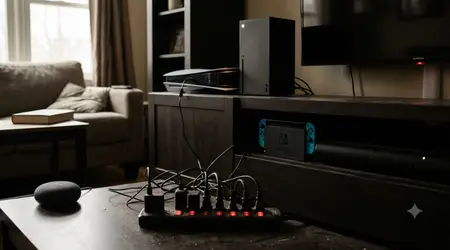
This is exactly how modern smart home components, game consoles and consumer electronics behave when they remain permanently connected to the power grid.
Most users ignore these devices because they require high performance during operation anyway.
However, the continuous base load created by standby mode adds up to a considerable waste.
A more conscious look at the smallest energy consumers often reveals enormous potential for savings.
Lack of awareness of idling
Many consumers assume that modern devices require virtually no electricity when in standby mode.
Manufacturers often advertise energy-efficient operating modes, but the reality in standby mode is unfortunately often different.
The internal transformers and receivers require a constant supply of energy to wait for the power-on command.
This misunderstanding leads to millions of devices worldwide drawing power from the grid completely unnecessarily.
There is a lack of transparent information about actual consumption in this specific condition.
Anyone who wants to optimize their electricity bill absolutely must start here and measure precisely.
++Making good use of excess PV power: Strategies instead of feeding it into the grid
The role of modern networking
The problem has actually worsened with the increase in smart home technology.
Every smart device in your home needs a constant connection to the router, which increases the standby power consumption drives it further upwards.
The convenience of controlling everything via app comes at a price in the form of constant electricity consumption.
We pay for the convenience of voice control and remote maintenance with a constant, small energy consumption.
While this amount is small per device, it adds up when you have twenty connected gadgets. You should always carefully weigh the convenience factor against the long-term electricity costs.
What impact will this have on the electricity market?
A look at the overall figures
According to a study by the German Federal Environment Agency, standby and idle losses alone account for approximately 6 to 8 percent of total electricity consumption in private households.
That's a huge amount, especially considering that it's almost entirely avoidable waste. A more conscious approach could free up entire power plant capacities.
If every household were to eliminate just half of this consumption, the savings at the national level would be enormous.
This is a collective problem that requires a collective solution. The market reacts slowly because consumers often don't actively seek out particularly efficient devices in this area.
See more: Heat pump instead of gas heating: How to make the switch
Hidden costs in the economy
Server standby modes and air conditioning systems cause significant costs not only in private households but also in huge office complexes.
Companies that want to improve their energy efficiency often overlook these small details. Yet, retrofitting with switchable sockets is often extremely cost-effective and highly efficient.
This illustrates the paradox: While we invest in new energy sources, we simultaneously waste energy through sloppy device management.
The first step towards true efficiency is always eliminating the unnecessary. Intelligent management begins with the power plug.
See also: Saving energy while cooking: Tips for kitchen & stove
The environmental impact of idling
Every kilowatt-hour that is consumed completely uselessly still has to be generated somewhere.
This puts a strain on resources and increases the necessary CO₂ production, which massively contradicts our global goal of the energy transition.
The standby power consumption It is therefore not only a financial problem, but also a real ecological one.
We need to understand that saving doesn't always mean cutting back. Often it's simply about eliminating inefficient structures. Saving electricity directly reduces environmental impact at the source.
How can consumption be reduced effectively?
Simple technical solutions
The most effective method is to use power strips with switches that completely interrupt the flow of electricity. As soon as the device is not needed, you "unplug" it.
This is a simple and extremely effective measure against unnecessary standby power consumption in all rooms.
For complex systems, master-slave sockets are also suitable, which automatically stop the flow of power to peripheral devices when the main device is switched off.
Such investments often pay for themselves within a few months through the savings on electricity costs. The technology is mature and now offers solutions for almost every scenario.
Measuring is better than guessing.
Many people underestimate their biggest energy consumers because they can't accurately quantify their consumption. A simple energy cost meter will give you complete clarity within 24 hours.
Often it is unexpected devices such as an old printer or a small charging transformer that drive up the counter.
Transparency is the first step towards improvement. Only when you see in black and white how much energy a device consumes while idle does its behavior usually change.
Measure your most important appliances to make targeted savings.
A shift in consciousness in everyday life
Habits are hard to change, but turning off devices is a routine that can be learned very quickly.
Integrate reaching for the power switch into your daily routine. When you leave the room, not only the lights but also any devices in standby mode should be switched off.
Over time, this will become second nature, and your electricity bill will thank you. It's a matter of discipline and awareness. Become an energy detective in your own home.
Comparison of power consumption in standby
| Device type | Typical standby power consumption | Annual costs (estimated value) |
| Smart TV | 0.5 – 2.0 watts | 2.50 – 8.00 EUR |
| Game console | 5.0 – 15.0 watts | 15.00 – 45.00 EUR |
| coffee machine | 1.0 – 3.0 watts | 4.00 – 12.00 EUR |
| Router (always on) | 5.0 – 10.0 watts | 20.00 – 40.00 EUR |
Conclusion and the way forward
The debate about the standby power consumption This clearly demonstrates that the biggest savings often lie in the small things.
Gaining control over idling not only saves money but also makes an important contribution to the environment.
By 2026, we will be technically able to almost completely eliminate this waste using simple means.
Imagine how many power plants would be unnecessary if every household implemented these small but effective steps.
It is up to each and every one of us to unplug unnecessary appliances.
How do you personally use your electronic devices to save energy? We look forward to your experiences and tips in the comments!
Frequently Asked Questions
Can constantly switching devices off and on damage them?
No, modern electronics are designed for switching operations; the risk of a defect is negligible.
Which electrical outlets are best suited?
High-quality power strips with surge protection and a fixed on/off switch offer the best safety and efficiency.
Why is there no law against standby mode?
There are already EU directives that limit standby power consumption, but many older devices or specialized electronics are not covered by these regulations.
Is it worth buying a measuring device?
Yes, a simple device costs less than 20 euros and quickly pays for itself by identifying "energy guzzlers".
What about the router?
Switching off the router is often inconvenient, but you can disconnect it from the network at night using a timer switch when no internet connection is needed.