
Saving energy while cooking: Tips for kitchen & stove
Advertisement
The topic Saving energy while cooking is more relevant than ever in 2025, for both ecological and economic reasons.
The kitchen is one of the biggest energy consumers in the household, often right after heating and hot water.
Even small, conscious changes in behavior can have a significant impact on overall consumption.
Those who cook smartly not only protect the climate, but also their wallets in the long run.
What role does the right equipment play in saving energy?
Choosing the right kitchen appliances and cookware is the first and most important step towards effective cooking. Saving energy while cookingOutdated or unsuitable devices waste enormous amounts of heat energy.
Modern induction cooktops are the efficiency standard here, as they generate heat directly in the base of the pan. This makes them up to... 50% energy efficient than conventional ceramic hobs.
Why is induction the efficiency champion in the kitchen?
Induction cooktops heat cookware via electromagnetic fields without significantly heating the cooking surface itself. The heat is therefore generated where it is needed: in the pot.
This results in minimal energy loss and a lightning-fast response time. Water boils faster, and the heat can be reduced immediately once the desired temperature is reached.
++ How to heat your water for free with solar thermal energy
How do I choose the best cookware?
The right cookware is crucial for the Saving energy while cookingPots and pans must lie flat and the diameter of the base must exactly match the size of the hob.
An unsuitable pot on a hob that is too large wastes up to 201T3T of energy. Heavy, high-quality materials such as cast iron or multi-layered stainless steel also retain heat longer.
See more: 10 myths about renewable energy – what’s really true?
What impact does the lid have on energy consumption?
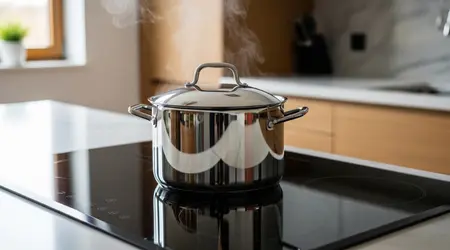
The lid is perhaps the most underrated energy-saving aid in the kitchen. Cooking without a lid consumes more energy. three times as much energy It's like having the lid closed, as the heat escapes unhindered.
This applies to both cooking on the stovetop and cooking in the oven. Using a tightly fitting lid keeps the heat in the pot, reduces cooking time, and saves energy.
Which cooking habits maximize energy savings while cooking?
Besides the equipment, it is primarily the daily routines and habits that achieve the greatest savings.
Mastering simple cooking techniques can noticeably reduce energy consumption.
The goal is to use the generated heat energy as intelligently as possible and to avoid unnecessary operating times of appliances. Planning your cooking is therefore always energy-saving cooking.
See also: What does energy efficiency class A+++ really mean?
How can I make the best use of the residual heat from the stove and oven?
Consistent use of residual heat is one of the simplest and most effective methods for Saving energy while cookingTurn off the stove or oven shortly before the end of the cooking time.
A classic example: Noodles or rice can often finish cooking in hot water with the lid on for the last five minutes.
The oven can be switched off ten minutes before the end when baking bread or casseroles to utilize the residual heat.
Why is pre-cooking with a kettle or pressure cooker more efficient?
For heating smaller amounts of water, an electric kettle is preferable to a stovetop. An electric kettle is generally more efficient because it heats only the water.
The pressure cooker is another champion, as it increases the cooking temperature through overpressure.
This can reduce the cooking time of legumes or stews by up to 70% shorten and thus saves a lot of energy.
What role do portion size and planning play in saving energy?
Cook efficiently and avoid unnecessarily heating too much water or using overly large pots. Cooking two eggs in a large pot heats an unnecessarily large amount of water.
Another key is planning: Cook large quantities at once (batch cooking) and reheat the leftovers later in the microwave.
The microwave is much more efficient for heating food than the stove or oven.
Why shouldn't food be thawed with hot water?
Defrosting food in the refrigerator overnight is the most energy-efficient method. Defrosting in the microwave is better than under running warm water.
Defrosting in the refrigerator has a double advantage: it simultaneously cools the surrounding food, which means the refrigerator needs less energy for cooling.
How do smart kitchen appliances and small appliances affect energy consumption?
Digitalization has also found its way into the kitchen, and smart appliances play an important role in cooking. Saving energy while cooking.
They enable more precise control and automatic optimization of cooking processes.
This isn't just about the stove, but also about small appliances that are often more efficient than the large main appliances. The conscious use of small appliances can significantly reduce overall energy consumption.
Are ovens more efficient than small kitchen appliances?
For heating small portions, ovens are almost always the most inefficient choice. An oven has to heat a large, empty space, which takes a lot of time and energy.
For toast, small pizzas or rolls, toasters, mini ovens or air fryers are significantly more economical.
These small appliances reach the required temperature faster and consume far less electricity.
What makes an air fryer so energy-efficient?
The air fryer is a prime example of Saving energy while cooking in the modern kitchen. It circulates hot air in a very small cooking space.
This means it heats up much faster and maintains heat more precisely than a large convection oven. For cooking small quantities, it is often the best option.
How do the analogies of the "Frugal Cooking Paddock" help me?
Imagine your kitchen as a Racing paddock Imagine a scenario where every appliance is a race car. The oven is the heavy long-distance truck that needs a lot of fuel (energy) to get going.
The induction hob is like an agile Formula 1 car, delivering instant power and quickly switching off again.
The microwave or pressure cooker are the most economical city cooking tools. Choose the most economical "vehicle" for each task.
What statistics prove the efficiency of induction cooktops?
According to the Federal Environment Agency (UBA) From 2024 onwards, switching from a conventional electric stove to an induction cooktop can reduce energy consumption for household cooking by up to 40 to 50 kWh per year reduce.
These savings accumulate over the years and demonstrate that the initial investment in efficient technology pays off in the long run. This is a clear argument for Saving energy while cooking.
Is the use of a range hood always necessary?
The extractor hood is necessary to remove grease and odors, but it also sucks the heated air out of the room. In winter, this results in a loss of valuable heating energy.
Use the extractor hood only when there is a strong odor and switch it off immediately after cooking. Does the extractor hood really always have to run at the highest setting?
Energy consumption and efficiency of different cooking methods
| Cooking method | Average efficiency (%) | Cooking time (e.g. 1L of water) | Money-saving tips (leverage) |
| induction hob | ~90% | Very fast (approx. 3-4 min) | Use the right pot size and utilize residual heat. |
| ceramic hob | ~60% | Slowly (approx. 7-8 min) | Use a lid, switch off early. |
| gas hob | ~50% | Medium (approx. 5-6 min) | Do not let the flame extend beyond the bottom of the pot. |
| microwave | ~70-80% (warm-up) | Very fast (seconds/minutes) | Use only for defrosting/heating. |
| oven | ~10-20% (heating up) | Very long | Use of convection (saves 15% compared to top/bottom heat). |
The consistent Saving energy while cooking It is a worthwhile task that requires little effort.
It begins with the intelligent choice of appliances and is perfected through conscious cooking habits.
From using residual heat to putting a lid on the pot, every small step contributes to climate protection and eases the burden on one's own budget.
Anyone who understands their kitchen as an efficient energy center will quickly realize that less energy consumption does not mean less enjoyment.
Share your best tips for saving energy while cooking in the comments! Which "energy-saving cooking paddock" strategy are you already successfully using?
Frequently Asked Questions
Is using convection when baking always more energy-efficient?
Yes. recirculating air is almost always more efficient than top/bottom heat, as the heat is distributed more evenly.
This allows you to lower the temperature by about 20°C and often forgo preheating, saving up to 15% of energy.
How much energy do I save by covering a pot?
Cooking without a lid can increase the energy consumption for heating water by up to... 300% increase.
The lid prevents water vapor and thus large amounts of heat energy from escaping unused.
Is it better to put a pot directly from the refrigerator onto the stove?
No. Ideally, food should reach room temperature before cooking.
When you heat cold pots or food directly, the stove has to use significantly more energy to compensate for the temperature difference.
What role does regular cleaning of the equipment play?
A clean kitchen is energy efficient. In particular, the oven seals must be intact to prevent heat loss.
A clean pot bottom also conducts heat better than a dirty one.
Can I save money on cooking by using a larger refrigerator?
Indirectly, yes. optimally stocked refrigerator (approximately two-thirds) uses less energy than an almost empty or an overfilled one.
Proper storage of ingredients also reduces food waste, which is also a form of Saving energy while cooking is.