
How to heat your water for free with solar thermal energy
Advertisement
Heat your water for free with solar thermal energy This idea is no longer a distant vision of the future, but an economically sound decision in 2025.
In light of soaring energy prices and stricter climate protection regulations, solar thermal systems are gaining significant importance. They use solar energy directly to generate heat.
Unlike photovoltaics, which generates electricity, solar thermal energy converts sunlight directly into heating energy.
This technology dramatically reduces dependence on gas or oil suppliers and lowers operating costs to almost zero. It is a key component of the energy transition in private homes.
What is solar thermal energy and how does the technology work?
Solar thermal energy is a mature and simple principle for generating heat.
Special collectors capture short-wave solar radiation and efficiently convert it into usable thermal energy. The system utilizes physical principles for optimal heat storage.
A closed loop transports the collected heat to the storage tank. A heat transfer medium, usually a mixture of water and antifreeze, circulates between the collector and the hot water storage tank.
++ Renewable energies for beginners: Here's how it works
What types of collectors are there and which are the most efficient?
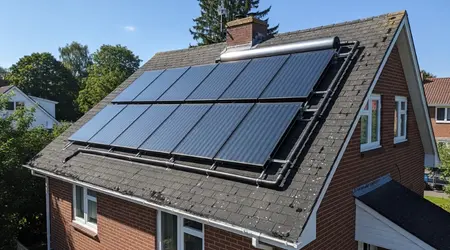
There are primarily two types of collectors: Flat plate collectors and Vacuum tube collectorsFlat plate collectors are more cost-effective and easier to install. They are well-suited for domestic hot water production only during the summer months.
Vacuum tube collectors are more complex, but significantly more efficient. They use a vacuum for insulation, which minimizes heat loss.
This means they deliver high heat output even with low solar radiation or cold outside temperatures.
See more: 10 myths about renewable energy – what’s really true?
How is the generated heat stored?
The collected heat is stored in a stratified charge storage or a Buffer storage stored.
This storage tank is the heart of the system and ensures the hot water supply, even when the sun is not shining.
A modern storage tank retains heat for extended periods with minimal losses. It thermally stratifies the water, so that hot water remains at the top and cooler water at the bottom of the tank.
See also: What does energy efficiency class A+++ really mean?
What is the difference to photovoltaics (PV)?
Photovoltaic systems generate electricity that is fed into the grid or used directly. Solar thermal systems, on the other hand, generate heat directly for hot water and heating support.
Both technologies utilize solar energy but serve different purposes in the home. Combining both systems (a hybrid system) offers the highest independence and efficiency.
Why is now the best time to heat your water for free with solar thermal energy?
Investing in solar thermal energy pays for itself faster today than ever before.
This is due to the sharply increased prices for fossil fuels and the attractive government subsidies. Economic viability is clearly established.
Furthermore, every installed collector contributes to achieving climate goals. The switch to solar energy is therefore both economically and ecologically imperative.
What government subsidies make solar thermal energy attractive?
In Germany, for example, the Federal Office for Economic Affairs and Export Control (BAFA) Attractive subsidies are available for solar thermal systems. These subsidies can cover a significant portion of the purchase costs.
Regional programs and low-interest loans from KfW (German Development Bank) are also available. This financial support drastically reduces the initial burden.
What are the potential savings?
A well-dimensioned solar thermal system can be installed in an average household. 50 to 65% to cover the annual hot water demand.
When used for heating support, an additional 15 to 30% of heating costs can be saved.
These savings are immediate, as solar energy incurs no ongoing operating costs. The initial investment often pays for itself within 8 to 12 years.
What role do rising CO2 prices play?
The continuous increase in the CO2 tax makes gas and oil more expensive year after year. Every kilowatt-hour of fossil energy saved through solar thermal energy avoids these rising taxes.
This increases long-term planning and cost certainty for homeowners. Heat your water for free with solar thermal energy It also means freeing you from future price risks.
How you can heat your water for free using solar thermal energy: Practical examples
The applications of solar thermal energy extend far beyond the shower.
The systems can be intelligently integrated into existing heating systems to increase their efficiency and save fuel. Their applications are diverse.
From classic hot water preparation to pool heating and central heating support, solar thermal energy is a true all-rounder. Here are two specific applications.
The classic hot water preparation in a single-family home
Mr. Müller in Bavaria installed a flat-plate collector system with a surface area of 5 m² and a 300-liter storage tank. In summer, the system covers 100%'s hot water needs for showers and kitchen use.
During the transitional seasons and in winter, the solar system serves as preheaterIt drastically reduces the required reheating power of the gas burner, saves gas and noticeably lowers Müller's energy costs.
Solar thermal energy for heating support in old buildings
Ms. Schmidt is renovating her old building and combining her new pellet heating system with vacuum tube collectors. The system is sized so that it can completely replace the heating system in spring and autumn.
The larger buffer storage tank (800 liters) supplies the underfloor heating with heat on sunny winter days.
Heat your water for free with solar thermal energy Not only does it reduce the load on the pellet heating system, but it also reduces costs and emissions.
How can the system be optimally integrated into the existing technology?
Seamless integration into the existing heating system (gas, oil, heat pump) is crucial for maximum efficiency. Modern solar storage tanks have two heat exchangers.
One unit is connected to the solar collectors; the other to the conventional heating system. Solar energy always takes priority, and the conventional heating system only switches on when needed.
What challenges need to be considered during the planning phase?
Although the technology is mature, there are key planning points that determine the success of the plant.
Incorrect dimensioning or unfavorable assembly can reduce efficiency.
The initial investment is high and requires careful, professional planning. All individual factors of the location must be taken into account.
What role do roof orientation and pitch play?
The optimal orientation of the collectors is south, with an inclination between 30 and 45 degrees.
Deviations, such as east or west orientation, can often be compensated for by the higher efficiency of the vacuum tube collectors.
Shading from trees or neighboring buildings must be avoided at all costs. Any shade drastically reduces yield and shortens the amortization period.
How can overheating (stagnation) be prevented in summer?
On hot summer days, especially during holidays, the system can enter the so-called stagnation This can lead to a problem. The heat can no longer be dissipated, and the collector temperature rises sharply.
Modern systems feature intelligent controls and cooling systems. The best approach is proper sizing: don't install more space than is needed.
What is a realistic payback period?
The payback period depends heavily on the initial investment, government subsidies, and local energy prices. For an optimally subsidized system in Germany, the payback period is between 8 and 12 years.
After that, the system literally produces free energy for hot water. Heat your water for free with solar thermal energy you for decades.
| criterion | flat plate collector | vacuum tube collector | Optimal application area |
| Efficiency | Medium (approx. 40-60%) | High (approx. 50-70%) | Warm months (hot water) |
| Cost | Low purchase price | Higher purchase price | Year-round use (heating support) |
| Heat loss | Higher (outdoor air contact) | Very low (vacuum insulation) | Cold/Cloudy days |
| Space requirements | Larger for the same yield | Less for the same yield | With limited roof area |
Conclusion: The sun as your personal heating source
The realization that you Heat your water for free with solar thermal energy, is today more than just an ecological conviction; it is a rational economic decision.
The combination of rising fuel costs and government subsidies makes the investment highly profitable and future-proof.
Solar thermal energy offers independence and makes a direct contribution to climate protection without restricting living comfort.
The initial investment is high, but the decades of savings and the resulting autonomy are unbeatable.
The technology is ready. Are you? Share your experiences with installing or planning your own solar thermal system in the comments!
Frequently Asked Questions
Can solar thermal energy provide sufficient heat even in winter?
Yes, modern vacuum tube collectors also provide heat in winter, especially to support heating or to preheat domestic hot water. However, they cannot completely cover the demand in winter.
Do I need to completely replace my gas heating system?
No, solar thermal energy is usually considered supplementary system installed. The best solution is a hybrid system, where the gas or oil boiler is only switched on when needed, when the sun is insufficient.
What happens if hail or storms hit the collectors?
Solar thermal collectors are extremely robust. They are tested for hail resistance and high wind loads according to European standards (EN 12975). The risk of damage is very low.
How long does a solar thermal system last?
Solar thermal systems have a very long lifespan. Quality manufacturers often offer a 10-year warranty, assuming minimal maintenance. 25 to 30 years amounts.
Is my roof suitable for solar thermal energy if it faces east?
Yes, an east-west orientation is possible and is frequently used.
Although the system delivers less heat at midday, it has a longer heat output in the morning and afternoon. This can be efficient if you need a lot of hot water in the morning.