
Making good use of excess PV power: Strategies instead of feeding it into the grid
Advertisement
Make good use of excess PV power significantly optimizes the economic profitability of modern solar power plants in 2026 while simultaneously protecting the overloaded public electricity grid from extreme voltage spikes.
Falling feed-in tariffs are forcing homeowners across Europe to intelligently consume the energy they generate on-site, instead of distributing it unused.
Traditional grid exports are rapidly losing financial value, which is why decentralized self-consumption concepts now form the foundation of the private energy transition.
This real-time analysis highlights the most efficient technological strategies that allow you to redistribute unused solar power directly within your household in a value-adding and sustainable way.
Key pillars of modern self-consumption optimization
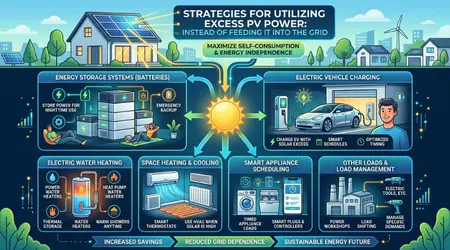
- Smart sector coupling: The direct linking of solar power with domestic heat generation and electromobility for maximum independence.
- Innovative battery storage systems: Strategic intermediate storage of midday energy for peak household consumption in the evening and at night.
- Intelligent load management: Automatic activation of household appliances precisely when the solar system achieves its highest production output.
- Dynamic network integration: Use of modern energy management systems to avoid curtailment and to reduce operating costs in the long term.
How does energy sector coupling work in the household?
Who his Make good use of excess PV power Anyone who wants to achieve this must break through the limitations of pure electricity generation and include other energy-related areas of the house.
Sector coupling connects the solar system directly with the heating system and the user's own charging station to completely eliminate fossil fuels in everyday life.
A modern residential building resembles a dynamic energy storage system that flexibly controls electrical, thermal and chemical capacities depending on the current weather conditions.
This intelligent distribution ensures that valuable energy remains within the system itself, instead of flowing into the public grid for minimal returns.
What role do modern heat pumps play in this?
A modulating heat pump converts excess electricity into thermal energy with high efficiency, which it then stores in the heating water or a hot water storage tank.
These heating systems continuously adjust their power consumption to the current production of the solar system, thus noticeably reducing grid consumption in winter.
++ Home energy storage systems 2026: Is energy storage still worthwhile?
How do smart wallboxes optimize self-consumption?
Smart charging stations immediately recognize when the solar panels are supplying more electricity than the household appliances inside the building are currently consuming.
They direct this excess energy directly into the battery of the electric vehicle, thus turning the car into a mobile energy storage device.
Why are home energy storage systems the foundation of energy independence?
The concept, the Make good use of excess PV power To be able to do this requires physical buffer capacities that compensate for the time discrepancy between generation and consumption.
According to recent statistical surveys by the German Solar Association, the installation rate of home storage systems for new installations in Germany has risen to an impressive 82 percent.
These figures demonstrate the growing need of consumers to effectively protect themselves against volatile electricity prices and unpredictable political interventions in the grid.
Lithium iron phosphate batteries now offer extremely high cycle stability, making long-term investment in this technology absolutely worthwhile from an economic perspective.
See more: Heat pump instead of gas heating: How to make the switch
How do energy management systems control the flow of electricity?
The central energy management system acts as a digital brain, comparing weather forecasts with the individual consumption behavior of the residents.
It decides in real time whether the solar power covers the current demand, charges the battery or fills thermal storage.
See also: Saving energy while cooking: Tips for kitchen & stove
What advantages do thermal storage systems offer compared to batteries?
Hot water storage tanks are significantly cheaper to purchase than chemical batteries and yet offer enormous capacity for long-term energy storage.
The following table compares the most important business and technical key figures of modern storage technologies for the current calendar year 2026.
Comparison of modern home storage technologies (2026)
| Storage type | Average investment costs | Lifespan in cycles | Primary purpose |
| Lithium iron phosphate | Mid-range price level | Ten thousand cycles | Short-term power supply |
| Solid state battery | High price level | Fifteen thousand cycles | Maximum safety requirements |
| Thermal storage | Low price level | Virtually unlimited | Hot water and space heating |
| Home hydrogen storage | Very high price level | Twenty years | Seasonal energy balance |
What practical strategies maximize direct solar energy consumption?
To the Make good use of excess PV power To be able to do this, consumers must adapt their daily habits to the natural rhythm of the sun.
A concrete example is the targeted programming of dishwashers and washing machines to run at midday via smartphone app or smart plug.
Another illustrative scenario shows the automated activation of an air conditioner at 1 p.m. to pre-cool the building using only solar power.
These small, coordinated adjustments reduce the expensive evening electricity purchases and increase the overall return on the solar system without any loss of comfort.
How does time-controlled load management work in everyday use?
Modern household appliances communicate directly with the router via standardized interfaces and only start operating when there is sufficient sunlight.
The system automatically shifts non-critical processes to sections with high energy production, thereby massively and measurably increasing the in-house energy consumption.
Why is it worthwhile to use heating elements?
An electric heating element in the buffer storage tank represents the simplest method to convert excess energy directly into usable heat.
This technology requires only minimal initial investment and noticeably relieves the primary heating system, especially during the transitional months.
Why is digitalization changing how we use solar power?
What good is the cleanest energy production on the roof if we cannot precisely control its distribution within the building?
The consistent implementation of the strategy, the Make good use of excess PV power The desire to achieve this is increasingly based on artificial intelligence and intelligent measurement systems.
Smart meters transmit consumption data every second, allowing control algorithms to react extremely quickly to load changes in the house.
This digital infrastructure even makes it possible to profitably share surplus electricity with neighbors in the region through virtual power plants.
How do dynamic tariffs affect self-consumption?
Dynamic electricity tariffs adjust to current stock market prices, which can make electricity consumption extremely cheap during the night hours.
Smart controls can selectively charge the home storage system with cheap grid electricity when needed, for example, when the sun has not shone sufficiently for days.
What future prospects does bidirectional charging offer?
The car of the future will not only absorb energy, but will also feed it directly back into the home network when there are shortages.
This technology will revolutionize the self-sufficiency of residential buildings and drastically minimize the need for stationary home storage systems in the coming years.
Conclusion: The future of private energy supply
The intelligent use of solar power will completely redefine the economic architecture of modern homes in 2026.
We have seen how sector coupling, smart battery storage and digital load management minimize dependence on traditional energy suppliers.
Anyone who blindly feeds electricity into the grid today is giving away money and burdening the general public with unnecessary grid overloads.
The tools for a successful, self-sufficient energy transition are available; we simply need to use them consistently and intelligently.
Optimize your systems before next summer to unlock the full financial potential of your solar power plant.
What strategy do you already use to optimally distribute your solar power within your own household? Share your experiences in the comments!
Frequently Asked Questions
Will battery storage still be economically viable in 2026?
Yes, due to the drastically reduced purchase costs for lithium iron phosphate cells, modern storage systems now pay for themselves within a few years of operation.
What should the ideal self-consumption rate of a modern PV system be?
Without storage, the value is usually around thirty percent; through intelligent sector coupling and home storage, rates of over eighty percent are achievable.
Can I simply retrofit an old solar system with a smart heating element?
Retrofitting is almost always possible without problems, provided that the control unit of the system has a compatible energy management system.
What happens to the excess energy when all storage units in the house are completely full?
In this case, the excess energy is automatically fed into the public power grid or the plant regulates production electronically.