
How to save electricity in everyday life – without changing your lifestyle
Advertisement
How to save electricity in everyday life, without giving up your comfort or lifestyle, is easier than you think.
With clever measures you can reduce your energy consumption, protect the environment and reduce your electricity bill at the same time.
At a time when the energy transition in Germany is gaining momentum and electricity prices continue to rise (according to Statista, average electricity costs in 2024 were 35.4 cents per kWh), saving energy is becoming increasingly important.
This article shows you practical, immediately applicable tips that can be seamlessly integrated into your everyday life.
Whether in the household, in mobility or in the home office, small changes make a big difference.
The energy transition is in full swing, and everyone can contribute. But why should we even bother with saving energy?
Besides the financial advantage – who wouldn't be happy about a lower electricity bill? – you are actively contributing to climate protection.
Renewable energies such as solar and wind power are booming, but the demand for fossil fuels remains high as long as consumption does not decrease.
This article offers you not only tips, but also a new perspective on sustainable living without requiring you to completely overhaul your daily routine. Let's find out together how you can achieve maximum impact with minimal effort.
Smart device selection: Efficiency without compromise
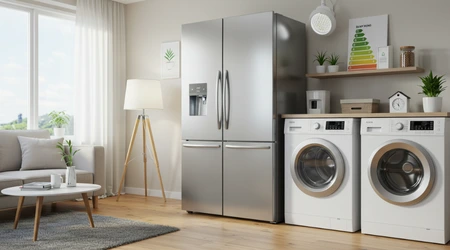
Modern household appliances are key to greater energy efficiency. Appliances with energy efficiency class A consume up to 50% less electricity than older models.
When buying a new refrigerator or washing machine, it's worth taking a look at the EU energy label.
A refrigerator in energy efficiency class A saves approximately 100 kWh per year compared to a class D refrigerator. At current electricity prices, this equates to savings of around 35 euros per year.
A real-world example: Anna from Munich replaced her old refrigerator with a Class A model.
++Buying energy-efficient appliances – what you really need to pay attention to
Without changing her lifestyle, she saved 120 kWh per year. Even small appliances like kettles or toasters are available in energy-efficient versions.
Look for models with automatic shut-off or Eco mode, which prevent unnecessary power consumption.
Additionally, it's worthwhile to maintain appliances regularly. A limescale-encrusted kettle uses up to 30% more energy.
Simple measures such as regular descaling or cleaning filters on washing machines increase efficiency without disrupting your daily routine.
Use lighting wisely: Lights on, costs off
LED lamps are a game-changer for energy consumption. They use up to 80% less electricity than conventional incandescent bulbs and last up to 25,000 hours.
Replace old incandescent bulbs with LEDs, especially in frequently used rooms like the living room or kitchen. Motion sensors in hallways or outdoor areas switch lights on only when needed.
Imagine leaving a 60-watt incandescent light bulb on for five hours every evening. With a 10-watt LED bulb, you save about 25 euros per bulb per year.
See more: Municipal energy transition: How cities become pioneers
In a multi-person household, this quickly adds up. For example: Max from Berlin completely converted his apartment to LEDs and reduced his electricity consumption by 200 kWh annually.
Also, make use of natural daylight wherever possible. Open curtains instead of turning on lamps, and place workspaces near windows. These small habits save electricity without sacrificing comfort.
Avoid standby mode: The invisible power drain
Many devices consume more electricity in standby mode than you might think. Televisions, laptops, and coffee machines can draw up to 100 kWh per year while idle.
Power strips with switches are a simple solution for completely disconnecting devices from the mains. Switch them off when you're not using them, for example at night or when you're away for an extended period.
Here's a trick: Group devices like your TV, game console, and soundbar on a power strip. One click, and everything is off.
See also: Energy certificate: obligations, costs and tips for landlords
Lisa from Hamburg saved €5 per month simply by consistently switching off her appliances. Smart plugs even offer remote control via an app, which is particularly convenient.
Also check your chargers: A forgotten phone charger plugged in consumes unnecessary electricity. Unplug it after charging to achieve small savings that add up.
Heating and cooling: Smart comfort
Heating accounts for approximately 70% of energy consumption in German households. A smart thermostat control, such as a programmable thermostat, can save up to 10% of heating energy.
Lower the room temperature by 1°C and you'll save about 6 euros on heating costs without getting cold. In the kitchen, you can save up to 30 euros on energy with simple tricks like using lids while cooking.
Ventilate in short bursts rather than continuously, especially in winter. Five minutes is enough to exchange the air without cooling down the walls.
A friend of mine, Tom from Cologne, uses smart thermostats and reduced his energy consumption by 15 % without sacrificing comfort.
In summer, fans instead of air conditioners help reduce electricity consumption. A fan only uses about 50 watts per hour, while an air conditioner can use up to 1,000 watts. This keeps the room cool without causing your electricity bill to skyrocket.
Save water, save electricity
Hot water preparation is a major electricity consumer. An instantaneous water heater or boiler often requires more energy than expected.
Showering for five minutes less can save you up to 200 kWh per year. Modern water-saving showerheads reduce water consumption by up to 50% without you noticing the difference.
Another tip: Set the washing machine to eco programs or low temperatures (30–40 °C).
This saves up to 40 kWh of electricity per wash cycle. Maria from Stuttgart uses eco programs and reduced her consumption by 80 kWh annually.
Avoid unnecessary preheating of the oven. Modern ovens reach the desired temperature quickly, and preheating is often superfluous. Such small adjustments add up over time.
Mobility and home office: Sustainable travel
Electric mobility is booming, but you can save money here too. Charge your electric car at night when electricity rates are often cheaper.
Use green electricity tariffs to minimize your carbon footprint. Car sharing or carpooling reduces energy consumption during commutes.
When working from home, you can save electricity by using energy-saving modes on laptops or monitors. Switch devices off completely after work. A colleague, Jonas from Frankfurt, uses an energy-efficient laptop and saves 50 kWh annually.
Cycling instead of driving for short distances is not only healthy, but also saves energy. Charging an e-bike costs only about 10 cents, while charging a car costs significantly more.
Digital helpers: Apps and tools for an overview
Energy apps like those from Tibber or aWattar help you monitor your consumption. They display real-time data and offer tips on how to save electricity in everyday life. Smart meters provide transparency and help avoid peak consumption.
A practical example: Sophie from Düsseldorf uses an app that analyzes her energy consumption. She discovered that her old freezer was a huge energy hog and replaced it. Result: 150 kWh less per year.
Use comparison portals like Verivox to find the cheapest green electricity tariff. Switching to a sustainable provider saves money and supports the energy transition.
Table: Overview of energy-saving tips
| measure | Annual savings | Expense |
|---|---|---|
| Use LED lamps | 200 kWh | Low |
| Power strips with switches | 100 kWh | Minimal |
| Eco programs washing machine | 80 kWh | Low |
| Smart thermostats | 150 kWh | Medium |
| Water-saving shower head | 200 kWh | Low |
Conclusion: Small steps, big impact
How to save electricity in everyday lifeIt's not a question of deprivation, but of smart choices. With simple measures like LED lamps, smart thermostats, or eco-programs, you can save up to 500 kWh per year – that's around €175 at current prices.
Every step counts, not just for your wallet, but also for the environment. So why not start today? The energy transition needs you, and your everyday life will remain as comfortable as before.
The combination of modern technology and conscious behavior makes the difference.
Whether through smart devices, the use of daylight, or switching to green electricity, you have the power to make a difference without completely changing your lifestyle.
Take the first step, and you'll see how easy it is to live sustainably.
Frequently Asked Questions (FAQ)
1. Is switching to LED lamps really worth it?
Yes, LED lamps save up to 80 kWh of electricity and have a long lifespan. The investment often pays for itself within a year.
2. How do I find out which devices consume a lot of electricity?
An energy meter or an app like Tibber shows you the consumption of your devices in real time.
3. Do I need to change my lifestyle to save electricity?
No, How to save electricity in everyday life, is based on small adjustments such as power strips or eco programs that hardly affect your everyday life.
4. Are green electricity tariffs truly sustainable?
Yes, if they offer certified green electricity. Look for seals like "ok-power" or "Grüner Strom Label".
5. How much can I save with a water-saving shower head?
A water-saving shower head can save up to 200 kWh per year, depending on usage.
With these tips you are perfectly equipped to How to save electricity in everyday lifeWithout compromise. Start today and become part of the energy transition!