
Buying energy-efficient appliances – what you really need to pay attention to
Advertisement
Energy-efficient appliances Appliances are key to a sustainable household. With rising electricity prices and growing environmental awareness, choosing the right appliances is becoming increasingly important.
But how do you find devices that truly save electricity and make everyday life easier at the same time?
It's not just about labels, but about smart decisions that reduce costs and protect the environment in the long run.
This article guides you through the most important aspects, from EU energy labels to hidden cost traps, with practical tips for 2025.
Imagine your household is an orchestra, each appliance an instrument that must play harmoniously to conserve resources. Ready to take up the baton?
Why energy efficiency is crucial
Energy-guzzling appliances in the home are a thing of the past. Modern energy-efficient appliances They significantly reduce fuel consumption without sacrificing comfort.
According to the German Federal Environment Agency, the electricity consumption of German households fell by 6.5 % in 2023 compared to 2008, thanks to stricter efficiency standards.
However, the increasing number of devices partially offsets this progress. So why act now? Because every kilowatt-hour counts for your wallet and the planet.
Sustainability is not a luxury, but a necessity. Energy-efficient appliances Appliances like refrigerators or washing machines save hundreds of euros annually.
++ LED lighting: Why switching is always worthwhile
For example, an A+++ refrigerator uses only 100 kWh per year, while an older model often uses over 300 kWh. The choice is yours.
Making a conscious purchase not only protects the environment but also your finances. Highly efficient appliances often pay for themselves within just a few years.
Consider this: What if your next purchase halved your electricity bill?
Decoding the EU energy label
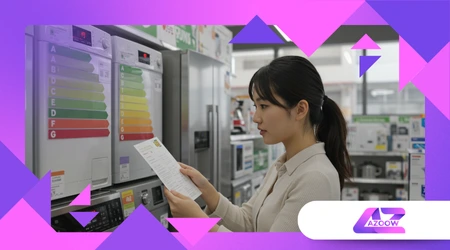
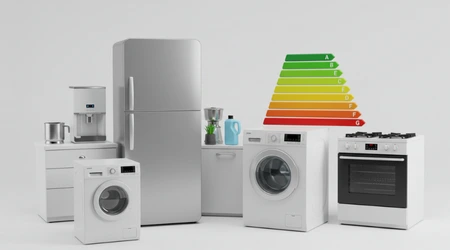
The EU energy label is your compass when buying appliances. It classifies energy-efficient appliances from A (best) to G (worst).
Since 2021, the A+ to A+++ energy efficiency classes have been abolished to provide consumers with clearer guidance. An A-rated appliance is now top-of-the-line.
In addition to the energy efficiency class, the label provides details such as annual consumption or water consumption.
A dishwasher in energy class A consumes approximately 135 kWh per year, while a class C dishwasher uses over 200 kWh. Check these figures carefully.
Beware of misleading information. Some manufacturers advertise "A" rated devices that, upon closer inspection, are only average. Always check the label directly on the device!
See more: Wind power for private households – Is a mini wind turbine profitable?
The Blue Angel – More than a seal
The Blue Angel is a trustworthy guide. It designates energy-efficient appliances from, which are environmentally friendly and durable.
Unlike the EU label, it considers the entire life cycle of a device. For example, a printer with the Blue Angel label not only saves energy but also uses recyclable materials.
This seal guarantees health and safety at work. It's worth looking for appliances with this mark, especially electrical appliances like vacuum cleaners. Quality pays off.
See also: Insulation made easy: The best methods for your home
Don't forget: The Blue Angel ecolabel is voluntary. Not every efficient appliance carries it, but its presence is a strong indicator of quality. Check the criteria online.
Avoid hidden costs
Energy-efficient appliances They often cost more to purchase, but the savings are enormous.
An A+++ rated tumble dryer saves over €140 annually compared to a C-rated model, assuming an energy consumption of 37.14 ct/kWh. Do the math!
Standby power consumption is an underestimated cost factor. Modern devices are only allowed to consume a maximum of 0.5 watts in standby mode. Switch devices off completely to avoid unnecessary costs.
Cheap appliances can end up being expensive. A low-cost refrigerator with a poor energy efficiency rating will drive up your electricity bill. Invest wisely in quality.
Practical tips for buying
When buying energy-efficient devices Research is key. Compare models on platforms like Topten.ch, which compare efficiency and price. For example, an A-rated refrigerator will save you more money in the long run than a B-rated model.
Pay attention to the appliance size. An oversized refrigerator consumes unnecessary electricity. Match the capacity to your household to remain efficient.
Take advantage of funding programs. ENTEGA offers subsidies in 2025 for energy-efficient appliances Class A or B. Check the terms and conditions before purchasing.
Technological Trends 2025
Energy-efficient appliances Washing machines will be smarter by 2025. Intelligent washing machines will adjust their consumption to the load, saving water and electricity. Innovations like these are crucial.
New EU regulations will further reduce standby power consumption. From June 2025, smartphones will be required to carry an EU energy label, making it easier to choose the right one. Find out more now.
AI-powered devices optimize energy consumption. For example, smart thermostats learn your habits and reduce heating costs. Stay up-to-date with the latest technology.
Comparison table: Energy efficiency classes and savings
| Device type | Class A consumption (kWh/year) | Class C consumption (kWh/year) | Annual savings (€)* |
|---|---|---|---|
| Refrigerator | 100 | 300 | 74,28 |
| dishwasher | 135 | 200 | 24,11 |
| tumble dryer | 138 | 526 | 144,07 |
*Based on 37.14 ct/kWh (as of 2025)
Integrating sustainability into everyday life
Energy-efficient appliances These are just one piece of the puzzle. Combine them with green electricity to further reduce your carbon footprint. Every decision counts.
Recycling is essential. Dispose of old devices properly to avoid hazardous substances. Many retailers offer take-back programs; make use of these.
Educate yourself further. Platforms like the German Federal Environment Agency offer guides to sustainable consumption. Informed consumers make the difference for a greener future.
Conclusion: Smart investments for the future
Energy-efficient appliances They are more than a trend, they are a necessity. With the right knowledge, you can save money and protect the environment.
From the EU energy label to the Blue Angel: Look for reliable certifications. Don't forget to think long-term; a higher purchase price pays off through lower operating costs.
Think of your home as an ecosystem: every device plays a role. Make conscious choices, take advantage of subsidies, and stay technologically up-to-date.
Your next purchase could be the start of a more sustainable everyday life. What are you waiting for?
Frequently Asked Questions (FAQ)
Which appliances are the most energy-efficient?
Appliances with an EU energy label A or the Blue Angel offer the highest efficiency. Refrigerators and washing machines in class A save the most energy.
Is it worth investing in more expensive equipment?
Yes, an A+++ rated tumble dryer saves up to €140 per year compared to a C-rated model. The investment pays for itself in the long run.
How do I find funding programs?
Check with providers like ENTEGA or local energy suppliers. Many are offering subsidies for 2025. energy-efficient appliances of classes A/B.
What is the Blue Angel?
An environmental label that distinguishes durable, environmentally friendly devices. It takes into account the entire life cycle, from production to disposal.
How can I avoid hidden costs?
Pay attention to standby power consumption and choose devices with a maximum of 0.5 watts in standby mode. Switch devices off completely.