
Wind power for private households – Is a mini wind turbine profitable?
Advertisement
Wind power for private households Mini wind turbines are a much-discussed option in the context of the energy transition. They offer the possibility of generating electricity independently while reducing CO₂ emissions. But is the concept truly profitable and practical for everyday use?
In this article, we will examine the most important aspects – from prerequisites and costs to economic efficiency and alternatives.
Why use wind power for your home at all?
In a time of rising electricity prices and growing ecological responsibility, more and more people are asking themselves whether they can produce their own electricity.
Photovoltaic systems are well-established – but what about wind power? Especially in areas where the wind blows frequently, a small, private system could be worthwhile. After all, wind is available around the clock, regardless of the time of day or weather conditions.
The appeal lies in the potential independence from the electricity grid. Those who generate their own energy protect themselves from price fluctuations and supply their homes more sustainably.
However, wind power is technically more complex than solar power plants, requires more permits and has higher entry costs.
Anyone interested in this technology must carefully examine the location, calculate the economic viability, and be aware of the maintenance costs and lifespan.
Besides the financial motivation, the environmental aspect is also decisive for many: Every kilowatt-hour of self-generated electricity reduces CO₂ emissions. In combination with storage solutions, the proportion of self-consumption can be increased – a step towards energy independence.
However, it's also true that not every location is suitable, and not every system delivers the promised performance. Therefore, it's crucial to carefully consider all aspects.
++ The best devices for reducing energy consumption.
What requirements must be met?
The most important basis for a functioning wind turbine is – unsurprisingly – wind.
However, occasional winds are not enough. For economically viable use, the average wind speed at the planned location should be at least 4.5 to 5 meters per second. The higher the value, the more efficient the electricity generation.
These conditions are often present in open fields or near the coast, but less frequently in built-up urban areas.
Besides wind speed, unobstructed airflow is also crucial. Buildings, trees, or other obstacles can cause turbulence and significantly impair the system's performance.
For this reason, mini wind turbines are usually installed on masts 10 to 30 meters high – this requires space, a stable foundation and often a building permit.
Those who live in rented accommodation or in a densely populated area will find it difficult to create suitable conditions.
Another point to consider is acceptance within the neighborhood. Wind turbines generate noise, cast shadows, and alter the landscape – aspects that should not be underestimated.
Legal regulations also require adherence to certain distances to neighboring properties. Finally, the technology itself plays a crucial role: only high-quality systems with good efficiency and a long lifespan justify the high initial investment. A thorough site analysis by experts is therefore essential.
How much does a mini wind turbine really cost?
Investment costs are a crucial factor for mini wind turbines.
Small systems with a power output of less than 1 kW are already available from around 1,000 euros – however, they often have a limited lifespan and low efficiency.
For robust systems with several kilowatts of power and professional installation, one should easily budget between €10,000 and €20,000. This does not include the costs for the foundation, mast, cabling, and possibly an inverter.
Not to be forgotten are the ongoing costs for maintenance and repairs.
Even though modern systems are durable, bearings need to be lubricated, rotor blades inspected, and electrical components regularly checked. Specialist companies estimate the average cost for this at 1 to 2 cents per kilowatt-hour generated.
Anyone who wants to use the system for many years should realistically factor in these costs – as well as possible downtime or spare parts.
Funding opportunities can help finance the investment. In Germany, some federal states offer subsidies for private wind power projects.
Low-interest loans from KfW or feed-in tariffs under the EEG (Renewable Energy Sources Act) are also available.
Nevertheless, the initial hurdle remains high – and only those who achieve high self-consumption and think long-term can realize economically viable use.
How economical is the business in everyday practice?
The central question remains: Is a mini wind turbine worthwhile in the long run? This depends largely on the location, the self-consumption rate, and the ongoing operating costs.
An example calculation shows that a 3 kW system with 40 % loads produces approximately 10,500 kWh per year. At an electricity price of 35 cents per kWh, this corresponds to a value of over 3,600 euros – but only if all the electricity is used on-site.
In reality, however, the self-consumption rate is usually lower. Excess electricity is fed into the grid, with the current compensation being around 8 cents per kWh – significantly below the purchase price.
Therefore, it makes sense to consume as much electricity as possible yourself or to connect it to a storage system. This can significantly increase profitability.
The payback period for a system – depending on the conditions – is between 10 and 20 years. This means that those who invest today will benefit in the long term – provided there are no major technical problems. Maintenance, insurance, and potential repairs must also be taken into account.
Overall, it is clear that profitability is possible, but only under optimal conditions and with clear planning.
What alternatives are there to mini wind power?
Not every location is suitable for wind power – but that doesn't mean you have to do without renewable energy.
Photovoltaics is by far the most widespread alternative. The modules are more cost-effective, easier to install, and require no moving parts – this significantly reduces maintenance and noise.
High self-consumption rates can be achieved in combination with battery storage systems.
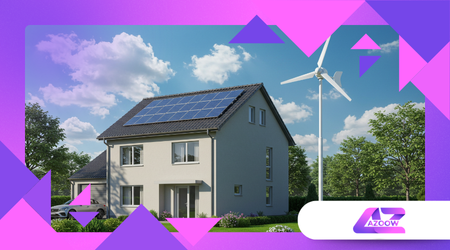
Another interesting option is the combination of solar PV and wind power. While solar panels generate electricity during the day when the sun is shining, wind turbines often produce energy at night or in bad weather. This allows the two to complement each other perfectly.
While these systems are more expensive, they offer a significantly more consistent electricity supply throughout the year. For tech-savvy households with sufficient space, this can be an attractive solution.
Furthermore, there is a growing number of innovations in the field of micro-power plants – such as fuel cells or mini combined heat and power plants (CHP units) that generate electricity and heat simultaneously. Those living in apartment buildings can also participate in community energy projects.
Frequently asked questions about mini wind turbines
How loud is a mini wind turbine?
Modern turbines are significantly quieter than earlier models, but still generate noise from rotor movement and the gearbox. This can be disruptive in quiet residential areas. Therefore, good planning also takes into account the distance to living spaces and neighbors.
Do I need a building permit for my wind turbine?
In most German states, yes – especially for masts over ten meters high. Building regulations apply, which vary regionally. Consultation with the local building authority is essential.
How long does a mini wind turbine last?
With proper maintenance and high-quality components, the lifespan is approximately 20 years. Some systems even last longer – provided they are regularly inspected and, if necessary, modernized.
Can I use all the generated electricity myself?
Theoretically yes, but in practice often only partially. Without storage, excess electricity is fed into the grid. Anyone wanting to be as independent as possible should consider battery storage or sector coupling with a heat pump.
What happens in calm weather or during a storm?
If there is too little wind, electricity production ceases – therefore, storage or supplementary systems are advisable. In the event of extreme storms, the systems automatically shut down for safety reasons to prevent damage.