
Balcony power plants put to the test: What small solar panels can achieve
Advertisement
Balcony power plants put to the test They prove in practice that the energy transition has long since arrived in urban areas and does not only encompass large-scale projects.
These mini solar power systems enable tenants and homeowners alike to actively generate electricity and immediately reduce energy costs.
The ease of installation is revolutionary. The technology, often known as plug-and-play solar, democratizes solar energy.
Anyone who owns a balcony, a terrace or a facade with good sun exposure can now become their own electricity producer.
This is a crucial step towards independence from large energy companies.
What exactly are balcony power plants and how do they work?
Balcony power plants are compact photovoltaic systems, consisting of one or two solar modules and an inverter.
They are fed directly into the household power grid via a special feed-in socket (Schuko or Wieland plug).
They work on a simple principle: The generated direct current is converted into household alternating current in the inverter.
This electricity is used directly in the household and immediately reduces the amount of electricity drawn from the grid. The entire system operates synchronously with the public power grid.
++ How to heat your water for free with solar thermal energy
How do current laws affect usage?
The federal government has significantly lowered the legal hurdles for operating these facilities.
In 2024, the maximum feed-in power was simplified, which increased the attractiveness of Balcony power plants put to the test further increases.
Registration with the network operator and in the market master data register has been greatly simplified.
This signals political support for decentralized energy generation. Bureaucratic requirements are now minimal, in order to promote citizen participation.
See more: 10 myths about renewable energy – what’s really true?
What electricity demand can a standard balcony power plant cover?
A typical 600-watt balcony power plant can cover the entire basic energy consumption of a household. This includes appliances such as refrigerators, routers, devices in standby mode, and lighting.
The energy generated is first used on-site, which can effectively reduce the electricity bill by 100 to 200 euros per year, depending on solar radiation and location.
With optimal orientation, self-consumption can reach up to 40% of the total demand.
See also: What does energy efficiency class A+++ really mean?
The solar cell as a mini filling station
The balcony power plant is like a small, personal gas station for continuous consumption in the household.
It constantly refills the tank (base load) with free solar power, so that less expensive fuel (grid power) needs to be purchased from outside.
What advantages do small solar power systems offer compared to large rooftop systems?
The main advantage of small solar power systems lies in their accessibility and mobility. They do not require complex permits, as they are not permanently attached to the property.
Tenants can simply take the system with them when they move. This is a crucial point, as tenants have traditionally been excluded from the expansion of solar energy. The investment is thus preserved for the long term.
Why is the installation so easy for laypeople?
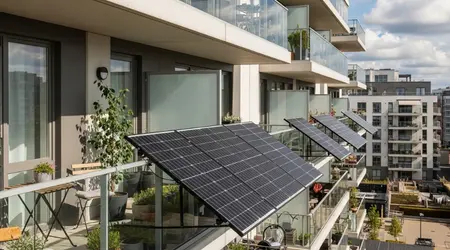
The installation of a balcony power plant is deliberately kept simple. The modules are attached to the balcony railing using brackets and connected via the inverter.
No in-depth electrical knowledge is required. The entire installation often takes less than an hour, saving time and installation costs. However, a qualified electrician is recommended for safe connection.
How do tenants benefit from direct use?
The generated electricity is used immediately in the household (self-consumption). Since self-generated electricity is significantly cheaper than expensive grid electricity, it is immediately cost-effective.
Unlike large-scale systems, where the focus is on feed-in tariffs, balcony power plants prioritize direct cost savings. The amortization period is very short.
Covering the basic load in the apartment
Imagine a household with a constant base load of 150 watts (refrigerator, router, etc.). A 300-watt balcony solar power plant completely covers this load at midday.
The electricity meters stand still while the sun shines, resulting in noticeable financial relief every day.
The profitability of Balcony power plants put to the test This proves it. The saved kilowatt-hours are worth real money.
What role do orientation and shadow play in performance?
The actual output of a balcony power plant depends heavily on its orientation and tilt. A south-facing orientation with a tilt angle between 30 and 35 degrees is ideal.
Even less ideal locations, such as east- or west-facing sites, can be profitable. You simply need to adjust your expectations for annual yield. Each orientation has its own specific advantages.
Why is a west-facing orientation attractive for employees?
A westerly orientation generates the main flow in the late afternoon and early evening hours.
This is ideal, as many people only come home after work and then consume the most electricity.
The west-facing system optimizes self-consumption during peak household load times. This maximizes cost savings, as very little electricity is wasted. Electricity usage is perfectly timed.
What happens to excess electricity when the grid is fully fed into the grid?
Without additional storage, excess electricity that is not currently being used in the household flows into the public grid free of charge. This is the biggest disadvantage of mini-systems.
Therefore, it is crucial to maximize self-consumption. Start large appliances, such as washing machines or dishwashers, specifically when the sun is shining most strongly.
How does temporary shadowing affect the modules?
Even slight shading, for example from a tree or a chimney, can significantly reduce the output of the entire module. Modern inverters (microinverters) mitigate this effect.
They ensure that each panel is individually optimized. This is an important test point for Balcony power plants put to the test in urban environments with many shadows.
What hurdles and future developments are shaping the market?
Despite the simplified legal situation, some hurdles still exist, such as the need for the consent of the landlord or the owners' association.
This slows the spread of the Balcony power plants put to the test still out.
Future developments will focus on intelligent control and storage options to make self-consumption even more efficient. Technology is constantly evolving.
How will the storage issue be solved for tenants?
Currently, small, mobile storage systems for balcony power plants are still relatively expensive. However, they make it possible to use the surplus electricity generated at midday in the evening.
These storage units are becoming cheaper and more compact. They are the logical next step to increase self-consumption up to 80% and make the system more profitable.
What are the advantages of smart inverters?
Modern inverters can monitor the actual power output and yield via an app.
Intelligent models can even selectively switch on household appliances (e.g., water heaters) when there is a surplus of solar power.
These smart control systems automatically maximize self-consumption. They optimize the overall efficiency of the system without requiring user intervention.
Smart home management
A system detects that the balcony power plant's battery is almost full. It sends a signal to the networked washing machine, which then automatically starts the washing program.
This is a perfect example of utilizing electricity that would otherwise flow into the grid uncompensated. Smart technology makes this possible. Balcony power plants put to the test even more powerful.
In 2024, the Fraunhofer Institute for Solar Energy Systems (ISE) estimated that the average amortization period for a 600-watt balcony power plant in Germany (at an electricity price of 35 cents/kWh) would be four to six years has decreased.
This makes the investment highly attractive and economically sound.
| criterion | Standard balcony power plant (600W) | Large rooftop system (e.g. 10 kWp) | Advantage of the balcony power plant |
| permit | Minimal (Simplified Registration) | Building permit application, network operator approval | Almost immediate commissioning is possible. |
| mobility | Tall (Transportable with relocation) | No mobility | Tenants can keep the investment. |
| Amortization | Short (4 to 6 years) | Longer (7 to 10 years) | Rapid financial return thanks to self-consumption. |
| focus | Maximizing self-consumption | Maximizing feed-in tariffs | Direct reduction in electricity bills. |
Conclusion: The Solar Revolution from Below
The Balcony power plants put to the test have impressively demonstrated their practicality and profitability.
They are the most important building block for the energy transition from the bottom up, as they enable citizen participation, regardless of home ownership.
The constant improvement of the technology and the falling prices make it a smart investment in independence from rising electricity prices.
Isn't it time you started making your own contribution to the energy transition right on your balcony? Share your installation experiences or your yield data in the comments!
Frequently Asked Questions
Do I need my landlord's permission for a balcony power plant?
Recent legal changes make installation easier, but the consent of the landlord or owners' association is legally required in most cases. still required (As of 2025). Be sure to check this before installation.
What happens if I generate more electricity than I consume?
The surplus flows into the public grid free of charge.
Since the systems are small, you usually receive a discount for them. no compensation from the grid operator, which is why self-consumption should be maximized. The grid operator will not pay for the electricity.
Does my electricity meter need to be replaced?
Yes. You need a modern, digital meter (so-called bidirectional meter or smart meter) that prevents meters from running backwards. The network operator usually replaces this free of charge.
Are the systems safe to install and operate?
Yes. The devices must comply with the VDE standard. However, it is advisable to have a electrician to be consulted for checking the house installation and for the connection (ideally via a Wieland socket).
How long do the solar panels of a balcony power plant last?
The modules are extremely durable. Manufacturers often guarantee a performance exceeding 80% of the original power for a period of 25 yearsThis means a very long lifespan for your investment.