
What do GOTS, OEKO-TEX & Co. mean? Sustainability labels explained.
Advertisement
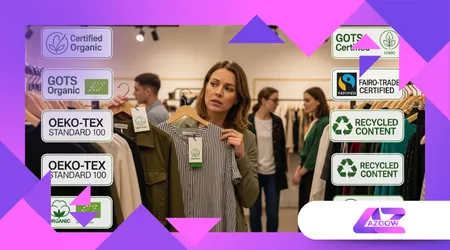
What do GOTS and OEKO-TEX mean? And the numerous other labels we encounter when buying sustainable fashion are often confusing for consumers.
The sheer number of certifications makes it difficult to distinguish between genuine commitment and greenwashing.
Only sound knowledge about these labels enables conscious purchasing decisions.
It is the responsibility of buyers to understand the standards behind the symbols. Only in this way can transparency be achieved in the complex supply chain of the textile industry.
Why are seals of approval indispensable in the textile industry?
Seals of approval are essential because they guarantee independent, verified checks of production standards. They offer end consumers necessary guidance in an opaque market.
Without these external controls, consumers would have to blindly trust every marketing promise. Seals of approval create trust and demonstrate compliance with ethical and environmental criteria.
++ Sustainable swimwear: Swimming in an environmentally friendly way
How do independent certificates prevent greenwashing?
Independent certifications require regular, unannounced audits by third parties along the entire value chain. This goes far beyond mere self-reporting by companies.
This strict monitoring makes it virtually impossible to label only individual, clean products while the rest of the production remains problematic.
See also: How sustainable fashion reduces your carbon footprint
What is the difference between product and company seals of approval?
Product seals such as GOTS They relate directly to the characteristics of an individual item and its manufacturing process. They guarantee certain material and workmanship standards.
Corporate certifications assess a company's overall performance, including its carbon footprint and corporate social responsibility (CSR). Both are important for a holistic evaluation.
See more: Fair Fashion vs. Fast Fashion: A Direct Comparison
Seal as school certificate
A sustainability label is like a School report card for a garment.
It shows not only the grade (the product) but also the processes (the production chain) that led to this result. It is an objectively documented performance record.
What does the Global Organic Textile Standard (GOTS) guarantee?
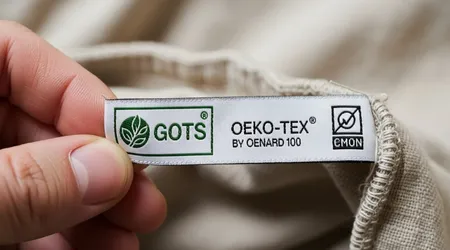
The Global Organic Textile Standard, or simply Global Organic Textile Standard GOTS, is the most demanding and comprehensive label for organic textiles. It covers both ecological and social criteria.
GOTS guarantees that at least 70% of the fibers come from controlled organic cultivation (kbA) and that the entire supply chain is subject to strict environmental regulations.
What strict environmental criteria does GOTS enforce?
GOTS prohibits the use of highly toxic chemicals, heavy metals, and toxic dyes during processing. This protects both the environment and the workers.
Water consumption and wastewater treatment in the factories are also strictly regulated. Protecting water resources is a central pillar of the GOTS standard.
How does GOTS ensure social responsibility?
GOTS mandates compliance with the core labor standards of the International Labour Organization (ILO). These include fair wages, the prohibition of child and forced labor, and safe working conditions.
These social standards must be verified and audited at every step, from the cultivation of the cotton to the finished garment.
The organic cotton sweater with GOTS seal
A sweater with the GOTS seal guarantees that the cotton was grown without pesticides (organic). Additionally, no harmful azo dyes were used in the dyeing process.
The entire manufacturing process, from spinning to garment production, was audited for fair wages and healthy working conditions. This is a genuine, holistic commitment.
How does OEKO-TEX Standard 100 differ from GOTS?
The OEKO-TEX Standard 100 is the world's best-known label, but has a fundamentally different focus than GOTS. It focuses exclusively on the The final product is free of harmful substances..
OEKO-TEX guarantees that the finished textile is harmless to health. However, it makes no statements about the ecological or social conditions of production.
What exactly does the OEKO-TEX Standard 100 test?
The seal tests for a very wide range of potentially harmful substances, including banned azo dyes, nickel, pesticides, and formaldehyde. It ensures that legal limits are met.
It is primarily a Health protection sealIt guarantees that the baby shirt or bedding will not trigger allergic reactions or release toxic substances upon skin contact.
Why doesn't OEKO-TEX replace an environmental label?
Since OEKO-TEX focuses solely on the final product, the use of toxic chemicals during the manufacturing process is not automatically ruled out. Factory wastewater may still be contaminated.
Therefore, combining different seals of approval is often useful. What do GOTS and OEKO-TEX mean? Together? The best choice for people and the environment.
Consumer confidence in Germany
A representative survey conducted by the Federation of German Consumer Organizations (VZBV) in 2024 revealed that 68% of German consumers the sustainability labels as most important decision criterion when buying textiles.
This underlines the need for transparency and strict standards.
Which special seals are gaining in importance?
In addition to the large, established certifications, specialized, often industry-specific labels are gaining increasing relevance. These focus on individual, particularly critical aspects of sustainability.
They offer a deeper guarantee for specific areas such as the use of recycled materials or compliance with strict animal welfare guidelines.
What does the Global Recycled Standard (GRS) certify?
The GRS The Global Recycled Standard (GRS) is of central importance for the circular economy. It certifies the actual recycled content of an end product.
The seal monitors the entire supply chain from collection to the finished product. It ensures that the declared fibers are truly recycled and not just virgin.
How is animal welfare ensured by the Responsible Down Standard (RDS)?
The RDS The Responsible Down Standard certifies down and feathers. It guarantees that the animals were not live-plucked or force-fed.
This seal offers ethical assurance when purchasing down products. It is an important criterion for everyone who values transparent animal welfare.
The certified functional jacket
An outdoor brand introduces a functional jacket that combines the best of both worlds. GRS-seal (for the use of recycled polyester) as well as the OEKO-TEX-seal (for being free of harmful substances) is carried.
This is a perfect example of the complementary use of seals. The purchase is good for the environment (recycling) and for the skin (no harmful substances).
| Seal type | Main focus | Most important criterion | scope |
| GOTS | Ecology & Social Issues (Holistic) | At least 70% organic fibers, fair wages | Textiles (clothing, home textiles) |
| OEKO-TEX Standard 100 | Health protection | The final product is free of harmful substances. | All textiles, skin contact |
| GRS | Circular economy | Verified percentage of recycled material | Textiles, but also other products |
| Fairtrade Cotton | Social welfare (basic income security) | Minimum prices and premiums for cotton farmers | Raw material cotton |
Conclusion: Strengthening responsibility through knowledge
The question What do GOTS and OEKO-TEX mean? And other signs is more than a question of knowledge; it is a call to responsibility.
These seals are the tools we can use to fight greenwashing and support genuine sustainability.
By specifically looking for GOTS, OEKO-TEX and GRS certifications when shopping, you promote transparent and fair production conditions worldwide.
Be an informed consumer: Which seals of approval will you examine more closely next? Share your most important purchasing criteria in the comments!
Frequently Asked Questions
Does GOTS automatically mean it is free of harmful substances?
Yes, GOTS prohibits many harmful substances that OEKO-TEX also tests for. A GOTS-certified product automatically meets high standards of being free from harmful substances.
What does the GOTS label “Organic in Conversion” mean?
This label is used for fibers that are in the process of being converted to organic farming. This supports farmers during the transition phase.
How can I verify the validity of a seal?
Most reputable labels (GOTS, OEKO-TEX) offer information on their website. Online database There you can enter the product or company license number to verify its authenticity.
Are organic labels for food and textiles the same?
No. The EU organic label only applies to food. GOTS is the most important, industry-specific organic label for textiles, as it covers the entire processing chain.
What does greenwashing mean in relation to textile labels?
Greenwashing occurs when companies make misleading or very weak claims that exaggerate environmental benefits. Genuine, external certifications counteract this trend.