
Garden care without chemicals: Here's how it works

Advertisement
Garden care without chemicals In 2025, it is more than just a trend; it is a necessity for environmentally conscious gardeners and the environment.
Avoiding synthetic pesticides and artificial fertilizers leads to a healthier and more resilient ecosystem right on our doorstep. The goal is a vibrant balance.
This natural gardening method promotes biodiversity and protects beneficial insects and soil life.
It proves that bountiful harvests and magnificent blossoms are possible even without aggressive chemical aids.
Why is healthy soil the basis of all chemical-free care?
Healthy soil is the foundation of Garden care without chemicals, as it makes the plants resistant to diseases.
Chemical fertilizers often disrupt the natural balance of microorganisms.
We must treat the soil as a living organism, rich in bacteria, fungi, and worms. These helpers ensure nutrient availability and optimal water supply for the plants.
++ Seasonal calendar for the city garden: What grows when?
How can you best promote microbial life in the soil?
The best method is the constant supply of organic material through Mulch and compostThis feeds the microorganisms, which in turn release nutrients for the plants.
Gardeners should avoid deep digging to protect the natural soil layers. This prevents unnecessary carbon loss and the destruction of the fungal mycelium.
See more: Micro-gardens in the kitchen: Fresh herbs always at hand
What role does compost play in the natural supply of nutrients?
Compost is the organic gardener's "black gold" because it provides essential nutrients in a form available to plants. It dramatically improves soil structure.
It increases water retention capacity and provides a wide range of trace elements. Regular, mature compost completely and sustainably replaces any artificial fertilizer.
See also: How you can store CO₂ with your garden
The soil as a living ecosystem
Imagine the soil as a complex forest. Each handful contains billions of organisms that form a network protecting and nourishing the plant.
When we use chemical fertilizers, we artificially overfeed the plants and often destroy this protective and vital underground network.
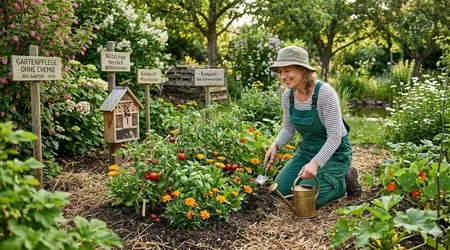
How does natural pest control work without pesticides?
Natural pest control is based on the principle of Prevention and the promotion of beneficial insects. It avoids the toxic arms race with pests that develop resistance.
A diverse garden with a high biodiversity It is the best bulwark against mass infestation, as natural predators keep the pests in check.
Why are beneficial insects the best allies?
Beneficial insects like ladybugs, lacewings, and parasitic wasps are the garden's natural police officers. They eat or parasitize pests such as aphids and spider mites.
To attract beneficial insects, gardeners must provide them with shelter and food sources, for example by planting umbellifers or providing insect hotels.
Which home remedies can effectively repel pests?
Simple home remedies often work excellently against acute infestations. Neem oil is an effective, natural insecticide that disrupts the reproduction of pests.
A mixture of soft soap and water can be used as a gentle contact spray against aphids. This works locally and is environmentally friendly.
The ladybug strategy
When a rose is infested with aphids, experienced gardeners do not use pesticides. They wait for natural predators or release ladybug larvae.
The larvae can eat hundreds of aphids per day and regulate the infestation without harming the plant or the environment. This is active biological pest control.
What role does diversity play in chemical-free environments? Garden care without chemicals?
Monocultures are susceptible to diseases and pests because they provide a continuous food source. Diversity is key to stabilizing the garden ecosystem.
Through Mixed culture and Crop rotation This slows the spread of specific diseases and promotes the vitality of the entire crop.
How does the positive influence of mixed cropping work?
Mixed cropping means growing different plant species next to each other that have a positive effect on one another. Some repel pests, others improve the soil.
A well-known example is planting onions next to carrots: the onions repel the carrot fly and vice versa. This is a natural symbiosis.
What is meant by the principle of crop rotation?
Crop rotation means not growing the same plant family in the same location for several years in a row. This prevents the accumulation of specific soil pests.
This is crucial to avoid soil fatigue and prevent diseases that are specific to certain plant families, such as clubroot.
Analogy: The garden as a healthy village
The Garden care without chemicals sees the garden as a healthy village.
Monocultures are like a city with only one type of inhabitant; when a disease strikes, everyone is at risk. Diversity ensures collective health.
How can we optimize the water cycle in the garden?
Efficient water management is essential in times of climate change. Chemical-free methods help to retain water in the soil and reduce irrigation needs.
The mulch layer plays a key role. It reduces evaporation and keeps the soil moist and cool, which saves water and reduces stress on the plants.
Why is irrigation water quality an important factor?
Rainwater is ideal because it's lime-free and provides optimal moisture to plants. Collect it in barrels to reduce your consumption of expensive tap water.
If tap water must be used, ideally let it stand in jugs. This allows some of the chlorine to evaporate and the temperature to adjust.
What role do water-retaining plants and mulch play?
Plants with deep roots, such as certain herbs or perennials, can draw water more effectively from deeper soil layers. They help the garden to better withstand periods of drought.
The mulch layer acts like a sponge, absorbing moisture and preventing the sun's rays from drying out the soil directly.
Pesticide use in the EU
According to Eurostat data (as of 2023), although sales of pesticides in the European Union have decreased slightly, the target of reducing their use by 50% by 2030 is still far from being achieved.
This demonstrates the urgent need for every garden to become a garden. Garden care without chemicals contributes.
| Chemical-free method | Purpose and function | Effective examples | Advantages over chemicals |
| Soil improvement | Promoting microbial life and soil structure | Compost, green manure, mulching | Long-term nutrient supply, water storage |
| Pest control | Encouraging natural predators | Insect hotels, ladybugs, mixed culture | Prevention of resistance, protection of the environment |
| Disease prevention | Strengthening plants and diversity | Crop rotation, garlic or onion manure | Increasing plant defenses |
| Weed management | Suppression of light and growth | Thick layer of mulch, hoeing, flame weeding | No herbicides entering the soil |
Conclusion: Returning to nature in your own garden
The Garden care without chemicals is a worthwhile investment in the health of the planet and our own quality of life.
It requires observation and patience, but the reward is a garden in harmony with nature.
The chemical-free garden is a refuge for bees, hedgehogs, and butterflies. It proves that we can achieve great things with small actions.
When will you start transforming your garden into a chemical-free paradise? Share your best tips and tricks for natural pest control in the comments!
Frequently Asked Questions
Is weed control without herbicides even possible?
Yes, absolutely. Regular hoeing, the strategic application of mulch, and targeted weeding of young weeds are very effective methods.
How do I fertilize heavy feeders like tomatoes without artificial fertilizer?
Use organic slow-release fertilizers such as well-rotted manure, comfrey liquid manure, or horn shavings. These release nutrients slowly and continuously.
What is green manure and why is it useful?
Green manure is the planting of plants (such as clover or mustard) that serve not for harvesting, but for soil improvement. They loosen the soil and bind nutrients.
Can I avoid using chemical sprays to treat fungal diseases?
Many fungal diseases can be prevented with plant-strengthening agents such as horsetail or garlic manure. Good aeration of the plants is also crucial.
How long will it take until my garden is truly chemical-free?
The transition is gradual. After about three years Through consistent chemical-free care, the soil life has largely regenerated and the ecosystem has noticeably stabilized.