
How to save money in the long term with LED lighting
Advertisement
How to save money in the long term with LED lighting The lighting in our homes and offices is often a hidden energy guzzler.
While we focus on large appliances such as refrigerators or heating systems, the consumption of old incandescent bulbs and halogen spotlights adds up over time to a considerable burden on the electricity bill.
The switch to modern LED technology is far more than just a trend; it is a fundamental economic decision.
This article reveals in detail, How to save money in the long term with LED lighting and why this investment is one of the smartest decisions for your budget and the environment in 2025.
We delve deep into the numbers, illuminate hidden savings potential, and show you how to approach the transition strategically.
Economic superiority: More than just electricity costs
The immediate reduction in electricity costs is the most obvious advantage of LEDs, but the true economic benefits extend across several levels.
The total cost of ownership (TCO) of a lighting system is determined by factors that go far beyond the meter reading.
The Efficiency Revolution: Watts versus Lumens
The most dramatic difference between LEDs and conventional light sources is the Energy efficiencyWhile a traditional incandescent lamp converts about 80% of the absorbed energy into heat, LEDs use almost all of the energy to generate light.
- Practical example: To produce the same brightness (about 800 lumens), a conventional incandescent bulb requires approximately 60 watts. A comparable LED bulb requires only 8 to 10 watts. This difference of 50 watts per light source quickly adds up. With just ten light sources, lit for four hours a day, you'll save over 730 kilowatt hours (kWh) annually. At an average electricity price of 35 cents per kWh (as of 2025), that's over €250 in energy costs alone.
Another often overlooked advantage: LEDs emit hardly any heat. In air-conditioned environments, such as offices or server rooms, the lower heat generation of the lighting leads to a lower load on the air conditioning system.
A 2023 study report by the Fraunhofer Institute for Solar Energy Systems (ISE) showed that in commercial buildings with intensive cooling, the cooling cost savings achieved by LEDs can, in some cases, amount to up to 20% of the direct electricity savings. This shows, How to save money in the long term with LED lighting through synergistic effects.
++ How heat pumps contribute to the heat transition and how to use them efficiently
Longevity: Less replacement, more peace of mind
Lifespan is the second major economic advantage of LED technology. While an incandescent bulb typically fails after 1,000 to 2,000 hours of operation, high-quality LEDs achieve a lifespan of 25,000 to 50,000 hours.
Imagine you light your living room for four hours a day. An incandescent bulb would need to be replaced approximately every six months. An LED bulb lasts over 30 years with the same level of use.
- Cost and time savings: The savings here are not only in the purchase price of the replacement lamps. In commercial and industrial environments, high Maintenance costs (working hours, lifting platforms, safety precautions).
- A field report from a large logistics center in southern Germany showed that switching to LEDs reduced annual lighting maintenance costs by over 90% because lamp replacement was almost completely eliminated. The initially higher acquisition costs are often amortized more quickly through these maintenance savings than through the savings in electricity costs alone.
Intelligent control: The hidden savings potential
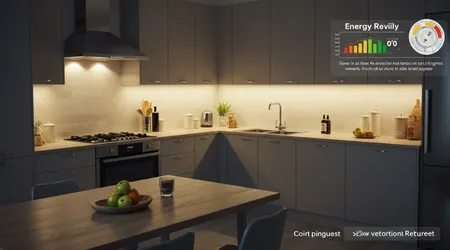
The real breakthrough in long-term cost savings lies in the Combination of LED technology with intelligent control systemsLEDs are digital and can be perfectly integrated into smart home or building automation systems.
See more: 10 myths about renewable energy – what’s really true?
Dimming, presence and daylight use
Intelligent LED lighting systems enable precise adjustment of the lighting intensity to actual needs.
- Presence and motion detectors: In hallways, storage rooms, or garages, lights are often left on unnecessarily. LEDs controlled by motion sensors save massive amounts of energy because they only light up when needed. Unlike energy-saving bulbs, LEDs reach their full brightness immediately, making them ideal for these switching cycles without negatively impacting their lifespan.
- Daylight control (Constant Light Output, CLO): In rooms with windows, the system automatically adjusts the brightness of the artificial lighting to the incoming daylight. Only as much electricity is consumed as necessary to maintain constant brightness. According to studies by the German Electrical and Electronic Manufacturers' Association (ZVEI), simply implementing CLO control in offices can save an additional 30 to 50 percent of lighting energy costs.
These smart features maximize savings and are key to understanding How to save money in the long term with LED lighting far beyond simply replacing a light bulb.
See also: What does energy efficiency class A+++ really mean?
Investment protection through future viability
The digital nature of LEDs offers an additional Investment protectionModern LED systems can be easily expanded and adapted through software updates and the integration of new sensors (e.g., for air quality measurement).
This means you don't have to replace the physical infrastructure every few years, but can improve its functionality through software upgrades.
This flexibility and future viability ensures that the initial investment in high-quality LEDs remains relevant and efficient for many years to come. A significant advantage in a rapidly evolving technological world.
Amortization: When the investment is really worthwhile
The main question for most consumers is: “When will I recoup the money for the more expensive LEDs?” The answer lies in a simple amortization calculation.
Calculating profitability
The economic viability of switching to LED lighting depends on three key variables: the initial cost of the LED, the price of the lamp being replaced, and the price of electricity.
| Light source (800 lumens) | Purchase price (approx. 2025) | Power (watts) | Lifespan (hours) |
| LED lamp | 7,00 € | 9 W | 30,000 hours |
| light bulb | 1,00 € | 60 W | 1,000 hours |
Calculation example (basis: 10 light points, 4 hours/day, 0.35 €/kWh):
- Annual additional consumption of incandescent lamps (10 lamps): 10 x (60W – 9W) x 4h/day x 365 days = 744.6 kWh
- Annual electricity savings: 744.6 kWh x €0.35/kWh = €260.61
- Additional purchase costs: 10 x (€7.00 – €1.00) = €60.00
- Payback period: 60.00 € / 260.61 € ≈ 0.23 years, so under 3 months.
This simple example illustrates: With intensive use, the investment in LEDs pays for itself extremely quickly. Added to this is the aforementioned reduction in replacement costs. The initial investment is marginal compared to the guaranteed long-term savings. It becomes clear and obvious, How to save money in the long term with LED lighting.
The psychological effect of savings
In addition to the pure numbers, the LED conversion also has a strong psychological effectAnyone who has switched their lighting to LED will experience an immediate and noticeable reduction in their monthly electricity bill.
This feeling of control and the visible success of the energy-saving measures taken motivates further energy-efficient decisions in the household.
This confirms that the change is not just a financial decision, but also an important step towards a more sustainable and more cost-effective lifestyle.
Conclusion: The inevitable investment in the future
The question of whether switching to LED lighting is worthwhile has long been answered. The initially higher purchase costs are offset by the extreme energy efficiency, the unprecedented longevity and the possibility of intelligent control. within a few months more than compensated.
Switching to LEDs is one of the few investments in a household or business that can have such a fast and guaranteed returns Anyone who still uses incandescent bulbs or inefficient halogen bulbs is literally throwing money out the window.
Anyone who strategically switches their lighting to LED and integrates intelligent controls knows exactly How to save money in the long term with LED lighting and at the same time make an important contribution to climate protection. Don't wait for the next blackout; switch now.
Frequently Asked Questions (FAQ)
Q: Are cheap LEDs from discount stores as good as brand-name products?
A: No. Cheap LEDs save energy, but often have a significantly shorter lifespan than the stated 25,000 hours and can produce poor light quality (low Color rendering index, CRI) and flickering.
With branded products, you pay for guaranteed longevity, consistent light color, and high-quality components. For long-term cost savings, quality products are the smarter choice.
Q: Do I need to replace my old transformers if I replace halogen spotlights with LEDs?
A: Yes, this is often necessary. Many older halogen transformers require a Minimum load, which is not achieved by the much more energy-efficient LED spotlights. This can lead to flickering or premature failure.
When changing from halogen to LED spots in recessed lights, you should ideally replace the old transformer with a special LED driver (also called LED power supply) which is designed for the low load of the LEDs.
Q: What color temperature (Kelvin) is best for the home?
A: The color temperature is a matter of taste and intended use:
- Warm white (2,700 K – 3,000 K): Ideal for living rooms, bedrooms, and dining areas. Creates a cozy, relaxing atmosphere (similar to an incandescent light bulb).
- Neutral white (3,500 K – 4,000 K): Good for kitchens, bathrooms, and work areas. Promotes concentration and provides clear light.
- Daylight white (> 5,000 K): More suitable for basements, garages, or offices with a particular need for bright, cool light (e.g., laboratories). Choose the appropriate temperature, as it does not affect how much you save in the long run with LED lighting.