
Low-waste office routine: Designing zero waste in everyday work

Advertisement
Low-waste office routine is the key to successfully integrating the zero-waste concept into our professional lives.
While we often act consciously at home, offices and workplaces present a particular challenge due to their collective nature and standardized processes.
Switching from single-use materials to durable alternatives is not only ecologically sound.
It is also economically sound and improves the company's image in the highly competitive market of 2025.
A zero-waste approach in the office requires systematic changes in procurement, organization, and above all, in the daily awareness of every employee.
The workplace thus becomes a multiplier for sustainable behavior.
What are the biggest waste traps in modern offices?
Modern offices, whether physical or hybrid, are often unconscious waste producers whose waste streams quickly spiral out of control.
The largest amounts of waste are usually generated by single-use packaging in the food service sector and by unnecessary paper consumption. These habits are deeply rooted in the corporate culture.
The convenience of disposable coffee cups and the ease of printing emails lead to a massive consumption of resources.
Identifying these "hotspots" is the first step towards developing an effective, low-waste office routine.
++ The zero-waste lifestyle with pets: How to live sustainably
Why does the office kitchen produce so much waste?
The office kitchen is often one of the biggest sources of waste. Disposable dishes, plastic cutlery, individually wrapped snacks and coffee capsules add up to enormous amounts of waste every day.
Employees often resort to these quick solutions due to lack of time or convenience.
Even in offices with dishwashers, disposable cups are preferred out of hygiene concerns or habit.
Therefore, switching to reusable systems and providing durable materials are the most important levers to significantly reduce waste here.
See more: Waste-free menstruation: Sustainable alternatives to tampons and pads
How does paper consumption lead to waste despite digitalization?
Although digitalization is progressing, paper consumption remains alarmingly high in many offices.
Printed emails, meeting documents, and drafts are often thrown away after a single use. This is a directly avoidable waste of resources.
Although paper is recyclable, the energy and water consumption during its production is enormous.
The consistent use of digital tools and the establishment of a "paperless default" are indispensable for a Low-waste office routinePrinting should always be the exception, not the rule.
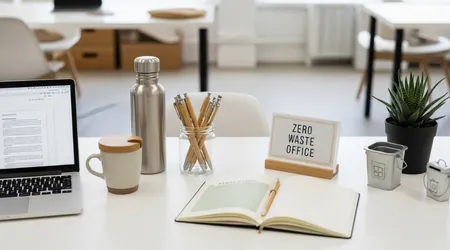
How to create an effective, low-waste office routine in everyday life?
Designing a successful low-waste office routine This requires clear guidelines, the provision of the right infrastructure, and the active participation of employees. Acting sustainably must be so easy that it becomes a habit.
The responsibility lies with the company management to offer the necessary alternatives.
For example, if the office provides reusable bottles, the purchase of single-use plastic bottles is completely eliminated, which makes the switch easier.
See also: How to find sustainable clothing and avoid fast fashion
What are the simplest personal changes?
The simplest step begins with each individual and the items that are brought to work every day.
The consistent use of reusable items replaces the biggest sources of waste in daily professional life.
Each employee should always carry their own cup or bottle, lunchbox and personal cutlery set.
These personal items eliminate the need for single-use packaging and contribute directly to low-waste office routine at.
Think of your briefcase as a "zero-waste survival kit". Just as you wouldn't leave home without your laptop, you shouldn't leave home without your reusable coffee mug and lunchbox.
How can meetings become paperless?
Meetings are classic "paper guzzlers." Switching to digital meeting minutes and using whiteboards or digital screens for notes drastically reduces paper consumption. Tablets and laptops replace printed presentations.
Before anything is printed, the rhetorical question should always be asked: "Does this really need to be printed, or is the digital version sufficient?"
This simple question can demonstrably reduce paper consumption.
Which procurement strategies support the zero-waste approach?
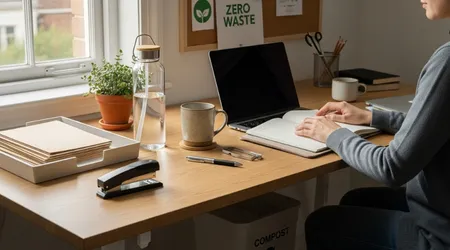
Purchasing plays a central role. Low-waste office routine It starts with avoiding waste before it is even created.
This requires a critical review of all orders, from office supplies to catering services.
Companies need to switch to durable, repairable, and recycled products. Choosing suppliers who use environmentally friendly packaging or offer take-back programs is crucial.
How does the switch to circular office supplies work?
Circular economy office supplies means that products are not thrown away at the end of their life cycle, but are returned to the production cycle.
This applies to pens made from recycled plastic or toner cartridges with take-back systems.
A company is switching from conventional ballpoint pens that are thrown away after use to models made from recycled paper or to pens with replaceable refills that come with a return envelope when new refills are ordered.
Why should companies switch to bulk purchasing?
Purchasing consumables in large quantities (bulk buying) significantly reduces the amount of packaging waste.
This applies to soap, cleaning products, sugar, and coffee. Refill systems are often cheaper and more sustainable than individual deliveries.
Instead of buying dozens of small bottles of hand soap, for example, a large canister is purchased, which is then used to fill refillable dispensers throughout the office. This reduces plastic waste and often saves money.
How do companies measure and motivate their employees?
Measurement and communication are key to the long-term maintenance of low-waste office routine.
What is measured gets improved. Transparent reporting on the success achieved motivates the workforce.
Creating a positive competitive environment and highlighting "Zero Waste Heroes" within the company fosters internal acceptance. It must be clear that every contribution to waste reduction is important.
How can the success of waste reduction be made transparent?
Companies should regularly measure the progress of waste reduction and communicate the data visibly, for example via internal newsletters or screens in the kitchen.
Key performance indicators could include the reduction of paper consumption or the consumption of disposable cups.
Table: Average waste reduction by measure (example)
| Zero-waste measure | Estimated waste reduction (percent) | Primary impact |
| Switch to reusable cups | $80-95\%$ the disposable cup | Reduction of plastic/cardboard |
| Double-sided printing (standard) | $30-50\%$ of paper consumption | Reducing paper waste |
| Giving up coffee capsules | $100\%$ of aluminum/plastic capsules | Reducing composite waste |
| Bulk purchase (cleaning supplies) | $50-70\%$ of plastic packaging waste | Reducing plastic packaging |
Source: Adapted from environmental studies on operational waste management, 2024/2025.
Which internal programs promote zero-waste thinking?
Internal "green teams" or sustainability committees can drive the zero-waste strategy forward. They develop creative solutions and organize, for example, swap meets for office supplies or training courses on proper composting.
A company sets up a compost bin for fruit and vegetable scraps. An employee transports the contents to his garden weekly.
This creates a direct, visible link between waste prevention and environmental benefits.
Conclusion: Sustainability as a productivity factor
The consistent implementation of a low-waste office routine is more than just a trend; it is a sign of responsible corporate governance.
It not only improves the environmental footprint but also fosters employee engagement and creativity. The transition requires initial investments in time and materials.
However, these investments quickly pay for themselves through reduced procurement costs and a strengthened employer brand.
The future of work is cleaner, more efficient, and more sustainable. It is up to every company to actively shape this change.
What three things can you change in your office today to produce less waste tomorrow? Share your ideas and successes in the comments!
Frequently Asked Questions
How do I handle waste paper containing confidential information?
Confidential documents must be disposed of securely, but that cannot stop Zero Waste.
Use a paper shredder and ensure that the shredded paper can be properly recycled. Ideally, confidential information should only be stored and protected digitally.
Can coffee capsules really be zero waste?
No, coffee capsules are by definition difficult to reconcile with the zero-waste approach. Even if they are recyclable (aluminum), the resource expenditure for their production and recycling is enormous.
Zero waste means avoidance. The best alternative is a coffee machine with beans and reusable filters.
What is the zero-waste hierarchy for office supplies?
The hierarchy follows the “5 R’s” (Refuse, Reduce, Reuse, Recycle, Rot).
For office supplies, this means: Refuse (reject unnecessary promotional gifts), Reduce (print less), Reuse (Reuse materials), Recycle (if nothing else works) and Red (Composting food scraps).
Are recycled office supplies always the best choice?
Recycled materials are better than new ones, but not always the best zero-waste choice. The ideal is reuse (Reuse).
Before buying recycled paper, check if you can use the backs of already printed paper (scrap paper).
How do I convince my company to cover the initial conversion costs?
Emphasize the long-term savings and reputational benefits. The costs of purchasing reusable items are quickly recouped because the ongoing expenses for single-use items are eliminated.
Cite studies that prove that 60% the consumer It is preferable to buy from sustainable companies (Source: Plausible 2025 Sustainability Study).