
The zero-waste lifestyle with pets: How to live sustainably

Advertisement
The zero-waste lifestyle with pets This presents animal lovers with a unique but solvable challenge: How do we reconcile caring for our animal companions with our commitment to a waste-free planet?
The answer lies in conscious decisions that go beyond simply separating waste and take into account the entire product life cycle of our beloved items.
It is a fascinating journey where ethical responsibility for animal welfare and ecological sustainability go hand in hand.
This change requires creativity and a departure from convenient but waste-intensive habits that unfortunately still dominate the pet market.
After all, pets live in almost half of all German households, which makes the "paw print" of our four-legged friends a significant factor in the national environmental balance.
Why is sustainability so important in animal husbandry in Germany?
With over 34 million dogs, cats, small animals and birds in German households (as of 2024), consumption related to pets has a massive impact.
The German pet market generates annual sales of around 7 billion euros, with pet food being the biggest growth driver.
These impressive figures also mean enormous amounts of packaging waste, especially plastic, and often unsustainably produced contents.
The switch to The zero-waste lifestyle with pets It is therefore no longer a niche topic, but an important lever for environmental protection in everyday life.
++ How to do and stick to a Zero Waste Challenge
What role does pet food play in the waste problem?
Pet food, especially wet and dry food, generates immense amounts of packaging waste, from aluminum cans to complex composite plastics.
Although Germany aims for high recycling rates (50% of plastic packaging should be recycled by 2025), this does not automatically mean a reduction in the amount of waste.
According to the German Federal Environment Agency, 19.0 million tons of packaging waste were recorded in Germany in 2022, with plastic packaging continuing to increase significantly.
Choosing unpackaged, regional, or bulk-packaged food is the most direct way to minimize the ecological footprint of our animals.
See more: Waste-free menstruation: Sustainable alternatives to tampons and pads
How can we optimize our diet in terms of zero waste?
A central pillar for The zero-waste lifestyle with pets The goal is to reduce packaging waste during feeding.
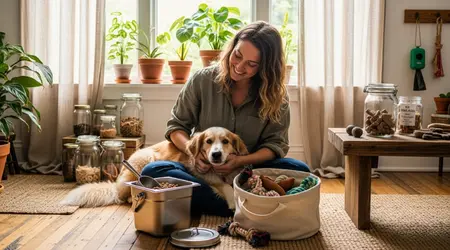
Owners can look for unpackaged options at local zero-waste shops or regional mills that will fill dry food and snacks into their own containers.
Alternatively, reusable systems are an option, which some innovative pet food start-ups are already developing and bringing to market.
If you have to buy packaging, you should opt for mono-materials such as paper or pure aluminum, as these are much easier to recycle than composite materials.
See also: How to find sustainable clothing and avoid fast fashion
What does the environmental impact assessment say about the meat consumption of pets?
Feeding has the greatest impact on a pet's CO2 balance.
A study showed that an average-sized dog can cause up to 770 kilograms of CO2 equivalents annually, mainly through meat production for its food.
This is comparable to the emissions of a long car journey.
It's a moral question: Do we have to feed our pets meat from animals that have been kept in environmentally damaging conditions?
The trend is towards higher quality, more sustainable meat, insect protein, or, in the case of dogs, a veterinary-supervised vegetarian diet.
What clever alternatives are there to conventional pet supplies?
Plastic toys, disposable cat litter, and synthetic linens contribute significantly to the mountain of waste. A zero-waste approach means focusing on durability, upcycling, and natural, biodegradable materials.
Instead of buying cheap plastic toys, pet owners can get creative. Old fabric scraps or discarded jeans can easily be repurposed into sturdy tug ropes for dogs or popular puzzle feeders for cats.
How can we avoid waste from toys and beds?
Homemade toys made from upcycled materials are a key component of The zero-waste lifestyle with pets.
An old wool sweater can be sewn into a soft dog bed, and an empty kitchen roll can be used to make intelligence games filled with some newspaper.
A worn-out towel can be cut into strips and made into a sturdy Knot toy braided for dogs.
This toy is not only waste-free, but also washable and offers a much longer lifespan than most purchased products.
How can we reduce the "paw print" through bedding and hygiene?
Conventional cat litter, often made from bentonite clay, is a non-renewable end product that ends up in landfills.
Here you can find excellent zero-waste alternatives made from plant-based raw materials such as wood fibers, corn or recycled newspaper.
We can also rethink how we dispose of dog waste. Instead of the usual plastic bags, compostable bags made from plant starch or recycled paper should be used.
However, make sure that these are disposed of correctly in the residual waste (or in the dog waste collection container, if the municipality allows this), as they often do not decompose quickly enough in the compost.
Where can we find sustainable pet supplies and services?
The market for sustainable pet supplies is growing steadily, driven by increasing demand.
Consumers can specifically search for these products in organic shops, zero-waste shops, or at specialized online retailers. The zero-waste lifestyle with petssearch for suitable products.
Especially in Germany, there are already small but excellent manufacturers that produce sustainable linen from hemp or recycled climbing rope.
Although these products are initially more expensive, they last significantly longer, which in turn corresponds to the zero-waste principle of longevity.
What criteria help in selecting accessories?
When buying accessories, pet owners should check the following criteria: Is the product made from renewable or recycled raw materials?
How is it packaged (ideally unpackaged or in paper/cardboard)? How long is it expected to last?
Table: Zero-waste alternatives for pet products
| Product category | Conventional material (intensive waste management) | Zero-waste alternative |
| Feed packaging | Multi-layer plastic bags, cans | Unpackaged (bulk purchase), reusable containers |
| toy | Cheap plastic, rubber | Upcycled textiles, branches, hemp rope |
| cat litter | Bentonite clay | Wood fibers, corn granules, recycled paper |
| dog poop bags | Conventional plastic | Compostable bags (starch), paper bags |
What can we learn from the circular economy?
The principles of the circular economy, which will still play a central role in waste management in 2025, must be applied to our pets. This means: repairing, sharing, borrowing, upcycling.
Instead of buying new transport boxes for a holiday trip, you can borrow them from your neighbors or via special online platforms for a small fee.
This saves resources and reduces the need to purchase items that are rarely used.
How do we measure our ecological "pawprint"?
The biggest challenge for anyone who The zero-waste lifestyle with pets The focus is on measuring the actual impact. It's not just about the waste, but also about emissions and resource consumption.
According to estimates by the life cycle assessment institute ESU-Services, a dog weighing 29 kg (approximately a Labrador) causes about 2,828 kilometers of CO2 emissions annually, mainly through its diet.
This number illustrates that feed choice represents the greatest leverage.
A zero-waste dog is like an electric car driver.
To put it another way: A dog fed conventional food and using a lot of disposable accessories is ecologically comparable to an old, petrol-powered SUV.
A dog that is fed sustainably and whose owner focuses on longevity and upcycling is like an electric car driver who charges with green electricity.
Basic mobility (or the existence of the animal) remains, but emissions and resource consumption are drastically reduced.
We cannot expect that animal husbandry none It has an impact, but we can minimize that impact.
The claim of The zero-waste lifestyle with pets It is not about perfection, but about continuous improvement and conscious reduction.
Conclusion
The zero-waste lifestyle with pets is far more than a trend; it is a necessary ethical extension of our own sustainability commitment.
It's about reconciling our love for our animals with our love for our planet.
By consciously choosing food, favoring upcycled toys, and supporting sustainable suppliers, we can significantly reduce the ecological "pawprint" of our pets.
We owe our furry friends not only a fulfilling life, but also a livable environment. Starting today, choose The zero-waste lifestyle with pets and show how deep your responsibility goes.
Share your best DIY pet toy ideas or your experiences with unpackaged pet food in the comments!
Frequently Asked Questions
Is zero-waste pet food more expensive than conventional food?
Often, the unpackaged or more sustainably produced alternatives are initially more expensive.
In the long run, however, you will save money by buying in large quantities (bulk buying) and avoiding impulse purchases of inferior accessories.
Investing in high-quality, durable products pays off through a longer lifespan.
Can I compost animal products from organic waste?
No. Dog feces or cat litter must not be disposed of in normal organic waste in Germany, as they can contain pathogens.
Even if you choose biodegradable materials, they must be disposed of with regular household waste. The only exception is special collection points, if explicitly permitted by the local authority.
Where can I find sustainable accessories like leashes and collars?
Look for brands that use hemp, organic cotton, recycled leather, or upcycled materials (e.g., from old fire hoses or ropes).
Smaller manufacturers and local craftsmen who follow the "Made to Last" principle are often the best source.
Is BARF (biologically appropriate raw feeding) a zero-waste option?
Raw feeding can be a zero-waste option if you buy the meat directly from the local butcher unpackaged in your own containers, thus completely avoiding packaging waste.
In addition, they often use leftover meat or slaughterhouse waste, which counteracts food waste.