
Energy self-sufficiency in the household: How realistic is independence?
Advertisement
Energy self-sufficiency household By 2026, it is no longer just a buzzword, but has become a concrete economic strategy for homeowners.
Given fluctuating electricity prices and technological advancements in home storage systems, many are asking: Is complete disconnection from the public electricity grid really feasible today?
This article examines the physical limitations and financial opportunities of a self-sufficient lifestyle.
We analyze the necessary hardware, the seasonal challenges, and the psychological freedom that comes with producing your own energy.
Reality shows that technological progress alone is not enough; it requires a smart combination of behavioral change and intelligent networking of components.
Those who invest today are not just building a house, but a private power plant that will last for generations.
Key points of the analysis
- The status quo: Where will we stand in 2026 regarding solar modules and battery technology?
- The 100 percent hurdle: Why winter remains the biggest challenge for self-sufficiency.
- Economy: When do the high initial investments in independence really pay off?.
- Technological synergies: The interplay of heat pumps, electric cars and bidirectional charging.
What is energy self-sufficiency in a household and how does it work today?
The concept of Energy self-sufficiency household describes the state in which a residential building covers its entire energy needs independently through renewable sources.
Households primarily use photovoltaic systems on roofs and facades for this purpose, combined with modern lithium iron phosphate storage systems for nighttime hours.
In practice, this means that no physical connection to the public network would be needed to manage everyday life.
Intelligent energy management systems (EMS) control consumption so that washing machines or dishwashers run precisely when the sun is at its highest.
A self-sufficient household today is like a sailing ship on the ocean; one cleverly uses the elements to move forward without external fuel.
While in the past only idealists pursued this path, today tangible return expectations and the fear of blackouts are driving development massively forward.
Modern home storage systems now achieve energy densities that were unimaginable just five years ago.
This technological evolution makes it possible to bridge periods of low wind and solar power lasting several days without loss of comfort, provided that the capacity has been correctly dimensioned to the size of the household.
How can you optimize self-consumption?
The key to success lies not in the size of the plant, but in the precise coordination between generation and manual or automated consumption.
Smart home solutions now integrate weather forecasts directly into the charging cycles of the storage system and the electric car, in order to ensure that no kilowatt hour goes unused.
Adjusting your habits to the position of the sun drastically reduces the required battery capacity.
This significantly reduces investment costs and makes the independence project financially attractive to a wider range of homeowners.
++ Home energy storage systems 2026: Is energy storage still worthwhile?
Why does the heat pump play a central role?
A heat pump converts excess solar power in the summer into hot water, which is stored in thermal storage tanks for the evening hours.
In winter, however, it must operate with high efficiency in order to optimally utilize the lower electricity yield of the solar modules for space heating.
This sector coupling is the backbone of any serious self-sufficiency planning in 2026.
Without including heating, true independence remains an unattainable goal, as thermal energy accounts for the largest part of consumption.
Why is true independence so difficult in winter?
Although the Energy self-sufficiency household While storage overloads are often provoked in the summer, the balance sheet for December and January is usually sobering.
Solar energy yields in Central Europe drop to about 10 to 20 percent of summer values, while heating demand reaches its maximum.
To close this gap, batteries would have to reach gigantic proportions, which usually makes no economic sense.
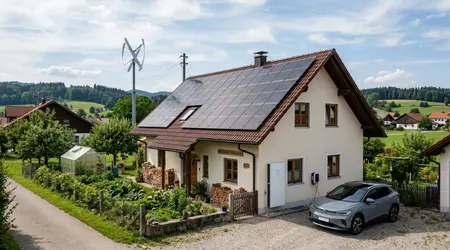
Therefore, many are relying on hybrid solutions such as small wind turbines for the garden or fuel cells powered by green hydrogen.
A practical example illustrates the dilemma: While a 10 kWp system easily delivers 1,500 kWh in July, it often only delivers 150 kWh in January.
This discrepancy requires either extreme sacrifices or very expensive long-term storage solutions that work chemically or thermally.
Nevertheless, progress is being made; highly efficient PV modules with heterojunction technology deliver considerable yields even in diffuse light.
These modules have been specially developed for regions with many cloudy days and noticeably improve the winter performance compared to older models.
See more: Heat pump instead of gas heating: How to make the switch
What role does green hydrogen play?
For single-family homes, there are now compact electrolyzers that convert excess summer electricity into hydrogen.
This is stored in secure pressure tanks and converted back into electricity and usable waste heat in winter via a fuel cell.
Although this technology is still expensive, it marks the boundary towards absolute year-round self-sufficiency.
For people in remote areas or with high security needs, this is the ultimate solution for uninterrupted self-sufficiency.
See also: Saving energy while cooking: Tips for kitchen & stove
Can wind power fill the solar gap?
Small vertical wind turbines are gaining popularity because they also work in turbulent winds in residential areas.
They often produce energy precisely when the sun is absent – during storms and in the dark night hours of autumn.
The combination of wind and sun drastically reduces the dependence on huge batteries.
It is the synergy of the sources that brings the dream of self-sufficient living within reach, without breaking the budget.
What are the financial advantages of energy self-sufficiency for a household?
If one considers the Energy self-sufficiency household As a long-term investment, it demonstrates impressive resilience to global energy market crises.
Those who produce their own electricity do not pay network charges, electricity tax and are immune to the price fluctuations of fossil fuels.
According to current data from the Fraunhofer Institute for Solar Energy Systems (ISE) from last year, optimized systems pay for themselves after just 8 to 12 years.
With a component lifespan of over 25 years, this means at least 13 years of almost free energy supply.
Wouldn't it be paradoxical to transfer large sums of money to energy companies every month while your own roof lies unused?
Investing in self-sufficiency is essentially an advance payment of electricity bills for the next two decades at a fixed, low price.
Additionally, a high degree of self-sufficiency significantly increases the resale value of a property.
In a world where energy efficiency ratings determine the affordability of loans, a self-sufficient house is a first-class asset for any retirement plan.
Current key figures on self-sufficiency (as of 2026)
| component | Degree of self-sufficiency (approx.) | Investment costs | life |
| PV system only | 30% – 35% | €8,000 – €12,000 | 30 years |
| PV + home storage | 70% – 80% | €15,000 – €25,000 | 15-20 years |
| PV + Storage + Wind | 85% – 90% | €22,000 – €35,000 | Variable |
| Complete self-sufficiency (including H2) | 100% | > €60,000 | 20 years |
Why are storage costs falling so quickly?
Due to the scaling of electromobility, battery cell prices have reached a historic low.
Home storage systems benefit directly from this, as they are often based on similar cell chemistries and are now being mass-produced.
At the same time, government funding programs have shifted the focus from simply feeding electricity into the grid to optimizing self-consumption.
This accelerates the spread of systems designed to decouple the household from the grid.
Conclusion: Is the dream of freedom realistic?
In summary, it can be said that a Energy self-sufficiency household up to a degree of 80 percent is technically and economically sensible for almost every homeowner today.
However, the remaining 20 percent require a disproportionately high financial investment or a radical lifestyle change.
We see that the technology is ready and costs are continuously falling.
Independence is no longer a binary state, but a scale on which everyone can position themselves according to their abilities in order to take responsibility for their own energy balance.
The path to self-sufficiency is a marathon, not a sprint; it begins with the first solar cell and ends with an intelligently networked home.
It is the safest insurance policy against an uncertain energy future that one can take out today.
Have you already taken the first step or are you planning to expand your storage capacity? Today's technology is the foundation for tomorrow's freedom.
Share your experiences with us in the comments and discuss the best strategies for winter with others!
Frequently Asked Questions
Is a photovoltaic system alone sufficient for self-sufficiency?
No, without storage you will usually only achieve 30 percent self-sufficiency, since the sun doesn't shine at night. For higher levels, a battery or other form of storage is absolutely necessary.
What happens during a power outage in the public grid?
Only systems with a special backup power or islanding function can continue to supply the house during a blackout. Standard systems usually shut down automatically for safety reasons.
Can I become self-sufficient even in a rented apartment?
Complete self-sufficiency is difficult, but with balcony power plants and small portable power stations, tenants can at least cover part of their needs themselves and reduce their costs.
How long do modern batteries really last?
Most lithium iron phosphate batteries installed in 2026 guarantee approximately 6,000 to 10,000 charging cycles. Under normal use, this corresponds to a lifespan of about 15 to 20 years.