
Urban gardens: Climate adaptation strategies for extreme years

Advertisement
Urban gardens Climate adaptation By 2026, it is no longer merely an option, but a vital necessity for our increasingly hot urban concrete deserts.
We are currently witnessing a drastic transformation of European urban landscapes, as extreme heat waves and sudden heavy rainfall events pose a massive challenge to traditional garden maintenance.
Gardeners today need to radically rethink their approach in order to protect their green oases against the unpredictable whims of a constantly changing global climate.
It's no longer just about aesthetics, but about resilient ecosystems that actively contribute to cooling our overheated neighborhoods and streets.
Those who do not act now risk losing painstakingly cultivated plant populations that simply cannot withstand the new thermal stresses of the big city.
Key aspects of resilience
- Water management: Intelligent storage solutions for long periods of drought.
- Plant selection: Mediterranean and drought-resistant species as the new standard.
- Soil science: Humus build-up to maximize natural moisture retention.
- Cooling effects: Strategic shading through vertical greening systems.
What are urban gardens for climate adaptation and why is it so critical today?
The targeted Urban gardens Climate adaptation describes the strategic redesign of private and public green spaces to effectively counter the physical stresses caused by extreme weather.
Cities often act as heat islands where temperatures hardly drop at night, which greatly increases the physiological stress for humans and flora.
A well-designed garden acts like a natural air conditioner, noticeably lowering the ambient temperature by several degrees through evaporative cooling.
Without these adaptation strategies, sealed surfaces turn into biological dead zones that store heat instead of mitigating it through natural processes.
Why do urban plants suffer more than forest plants?
In the city, asphalt and glass walls reflect solar radiation directly onto the leaves, leading to severe burns on the plant tissue.
Furthermore, soil sealing prevents rainwater from seeping deep into the ground, which often leaves the roots dry even after heavy rainfall.
Furthermore, urban soils are often compacted, which hinders gas exchange and massively disrupts the vital symbiosis with mycorrhizal fungi in the root area.
These factors make our urban gardens an ecological front line that requires a completely new form of horticultural attention and expertise.
++ Permaculture plant combinations in the city for stable harvests
What role does biodiversity play in adaptation?
A garden with high biodiversity stabilizes itself during extreme weather events, as different plant species react differently to heat or wetness.
Monocultures, on the other hand, collapse completely during a single heat wave, as all individuals have the same low tolerance threshold to thermal stress.
The combination of deep-rooted plants and ground cover creates a microclimatic protective shield that drastically reduces evaporation from the soil and retains moisture.
Biodiversity acts here as an ecological insurance policy, successfully preventing the total failure of green infrastructure even in extreme years like 2026.
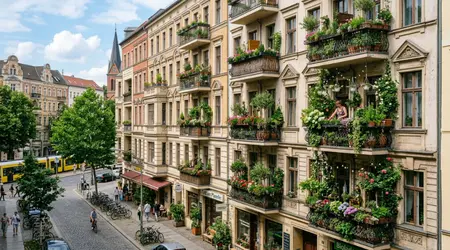
How does efficient water management work in extreme years?
The modern Urban gardens Climate adaptation It relies on the principle of the "sponge city", where every drop of rainwater is stored locally in the ground.
Instead of wasting precious drinking water, clever gardeners today use underground cisterns and open infiltration basins for the natural irrigation of their fields.
Mulching with organic material or special mineral substrates also prevents the sun's radiation from directly drying out and crusting the top layer of soil.
Studies by Humboldt University in Berlin showed as early as 2025 that mulched beds require up to 40% less additional irrigation than open soil areas.
See more: Make your own sustainable garden furniture and decorations
How do you save your garden during a total water shortage?
In extreme droughts, only precise drip irrigation helps, directing the water directly to the roots instead of spraying it over a large area.
Watering in the evening minimizes evaporation losses, but deep penetration of the soil is more important than daily, superficial moistening of the top layers.
Plants should be trained to develop deeper roots by watering less frequently but much more intensively, which massively increases their natural resilience.
Gardening in 2026 means understanding water as a precious resource, the management of which determines the success or failure of the entire operation.
See also: Urban Farming vs. Urban Gardening: What is the difference?
Which technical aids are useful?
Sensor-controlled systems measure soil moisture in real time, thus preventing overwatering or critical drying out of sensitive crops in containers.
Smart apps now allow irrigation to be automatically adjusted based on local weather forecasts before the next heat wave actually reaches the urban area.
These technologies are like a digital guardian angel for the garden, intervening when humans overlook the subtle signs of drought stress.
Nevertheless, the gardener's powers of observation remain irreplaceable in order to respond flexibly and professionally to the individual needs of different plant communities.
Which plants are the winners of the new climatic reality?
A core element of the Urban gardens Climate adaptation This represents a shift away from thirsty classics towards robust, future-oriented species from drier climate zones around the world.
Plants with silvery-haired leaves or thick, succulent storage tissues reflect sunlight and evaporate significantly less water than large-leaved, soft ornamental plants.
Wild perennials such as the gaura or various types of sage also provide food for insects, which also suffer from the heat in the city.
It is an aesthetic reorientation that brings the charm of the steppe and the Mediterranean directly into our backyards and onto our roof terraces.
Why are native wild plants still important?
Although we need drought-resistant exotic plants, many native wildflowers remain the best choice, as they are perfectly adapted to local soil conditions.
Species such as the knapweed or the viper's bugloss have developed deep taproots that can draw water from deep layers even in extreme years.
They form the backbone of urban fauna and ensure the survival of wild bees, which remain absolutely essential for the pollination of our crops.
The mix makes the difference: A hybrid of Mediterranean robustness and local adaptability creates the most stable green spaces for the modern metropolis.
How do you integrate edible permaculture into heat adaptation?
Permaculture principles utilize layered planting, in which tall fruit trees provide the necessary light shade and protection for smaller vegetable plants in the height of summer.
Climbing plants such as grapes or hops cool house walls and produce harvests at the same time, while reducing the thermal pressure on the surrounding beds.
Imagine your garden like the edge of a forest: each plant protects the others from wind and direct, burning midday sun through clever positioning.
This clever design allows us to make optimal use of the limited space and create a productive ecosystem that still functions even at 40 degrees Celsius.
Current data on urban warming 2026
This year's statistical surveys show that cities without active greening measures become up to 12 degrees hotter than their rural surroundings.
The following table shows the direct influence of different floor coverings on the surface temperature on a typical summer day in a German metropolis.
Comparison of surface temperatures (measurements from 2026)
| Surface type | Temperature (°C) at 30° air | Cooling effect |
| Asphalt road | 54°C | None (heat storage) |
| concrete paving | 48°C | Minimal |
| lawn area | 32°C | High through evaporation |
| Intensive garden | 28°C | Very high |
| Vertical greening | 26°C | Maximum protection for walls |
What does this statistic tell us?
The data impressively demonstrates that Urban gardens Climate adaptation has a direct impact on the quality of life and energy costs for building cooling in the neighborhood.
A greened street significantly reduces the need for air conditioning in interior spaces, as the natural shading massively prevents the building structure from heating up.
Is this a worthwhile investment?
Municipalities often promote the conversion today with subsidies, as the relief of the sewer system during heavy rain through unsealed gardens saves millions in infrastructure costs.
From an economic perspective, every euro invested in the climate resilience of the garden contributes to the long-term increase in value and preservation of the private property.
Conclusion: The Green Revolution in the backyard
In summary, adapting our gardens to the new climate is no longer a distant dream of the future, but a lived reality.
We need to conserve water, promote biodiversity, and radically adapt our plant choices to the heat in order to permanently secure urban quality of life.
The garden of the future is not a static image, but a dynamic system that actively reacts to the environment and protects us from extremes.
Let us work together to transform our cities into cooling, green oases that will remain livable and healthy for future generations.
Let's not wait for the next heat record; let's start today to make our green paradises fit for the challenges of the coming years.
Have you already gained experience with drought-resistant plants or do you use rainwater harvesting systems? Share your tips in the comments!
Frequently Asked Questions
Which plants can best withstand extreme heat on the balcony?
Succulents, lavender, rosemary and geraniums are particularly suitable, as they can store water in their leaves and have a high UV tolerance.
How can I tell if my soil retains enough water?
A simple test: If water beads up immediately after watering, the soil lacks humus. Mix in compost to sustainably improve the soil's sponge-like properties.
Is artificial turf an alternative in dry conditions?
No, artificial turf heats up extremely and does not contribute to cooling. For genuine cooling, opt for low-maintenance gravel gardens with deep-rooted prairie plants.
Is it okay to water my plants in the summer despite the water shortage?
Check local regulations. Generally, using collected rainwater is always permitted and is the most efficient irrigation method.