
Urban Farming vs. Urban Gardening: What is the difference?

Advertisement
Urban farming vs. urban gardening is a debate that will make our cities greener by 2026 and fundamentally revolutionize the way we supply our food.
While many people use these terms synonymously, they actually represent completely different concepts with different goals for our society.
The distinction between commercial production and private leisure defines how we use the limited space in metropolises.
In this article, we will explore the nuances of these green movements so that you know exactly which model suits your lifestyle.
What is the actual difference between the two concepts?
Regarding the question Urban farming vs. urban gardening It is primarily about the intention behind the shovel and the seed.
While one aims for profit and efficiency, the other focuses on community and personal relaxation outdoors.
Cities like Berlin or Munich impressively demonstrate today that both models can coexist to promote local biodiversity.
Nevertheless, the economic component remains the decisive separating factor between a farm and a garden.
How does urban farming work in practice?
Urban farming describes the professional, often profit-oriented production of food within or on the outskirts of densely populated areas.
It uses state-of-the-art technologies such as hydroponics or aquaponics to achieve maximum yields for the local market in the smallest possible space.
These businesses operate like companies, supplying supermarkets, restaurants, or subscribers directly with fresh vegetables, herbs, or even fish.
Efficiency is the main focus here, in order to drastically shorten transport routes and conserve resources such as water in the cycle.
++ Make your own sustainable garden furniture and decorations
Why is urban gardening more of a social project?
Urban gardening, on the other hand, is usually not profit-oriented and often takes place on communally used areas or private balconies.
Here, social interaction, environmental education, and the joy of gardening are the focus of daily activities.
The harvest usually ends up on one's own plate or is shared among neighbors without any money changing hands.
It is a valuable retreat for city dwellers seeking a deeper connection to nature and their neighborhood.
See more: How to find or start a community gardening group
What role does land use play?
A key aspect of Urban farming vs. urban gardening This includes access to land and the duration of lease agreements.
Farmers need long-term security for their expensive equipment, while gardeners often operate mobile beds on temporary land.
Commercial enterprises often use the roofs of industrial buildings or empty basements for so-called vertical farming.
Community gardens, on the other hand, often revitalize neglected brownfield sites in the neighborhood and make them accessible to all citizens again.
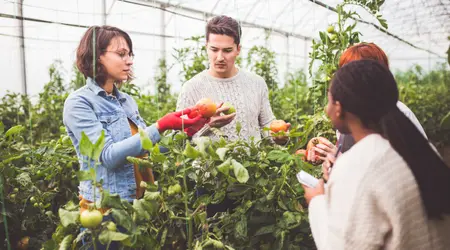
What advantages do these green trends offer for our cities?
The confrontation with Urban farming vs. urban gardening shows that both approaches improve the urban climate and effectively counteract heat islands.
The unsealing of soils and the evaporation from plants noticeably lower the temperature in hot summers.
In addition, these areas serve as important corridors for insects and birds, which would otherwise have little chance of survival in concrete deserts.
Both concepts transform grey infrastructure into living, breathing ecosystems that massively improve our quality of life.
See also: Zero waste in the garden: Gardening without waste
Why does urban farming improve food security?
By producing locally, urban farming minimizes dependence on global supply chains, which is invaluable, especially in times of crisis.
Fresh products reach the consumer from the producer within a few hours, which helps to better preserve vitamins and nutrients.
According to a study by Technical University of Berlin Urban agricultural areas could theoretically cover up to 20 % of a city's vegetable needs.
This not only reduces the CO2 footprint through less truck traffic, but also strengthens the regional economy.
How does urban gardening promote mental health?
Urban gardening offers an essential counterbalance to the stressful daily work routine and has been proven to help reduce stress hormones.
Those who put their hands in the earth experience a direct sense of self-efficacy that is often lost in the digital age.
Community gardens foster new friendships across social classes and age groups, strengthening social cohesion.
It is the healing power of nature that can be experienced here by every citizen without performance pressure.
What is the ecological added value of both approaches?
Both movements promote the preservation of old cultivated varieties that have long since been replaced by standardized hybrids in industrial cultivation.
By foregoing chemical pesticides in these projects, valuable biotopes are created in the heart of urban areas.
Rainwater is stored on these surfaces instead of flowing unused into the sewer system, which relieves the infrastructure during heavy rain.
The comparison Urban farming vs. urban gardening This shows that every plant counts for a sustainable tomorrow.
Why is the comparison between urban farming and urban gardening so relevant today?
In 2026, the discussion about Urban farming vs. urban gardening long since arrived at the heart of urban planning.
Today, architects already integrate green spaces for residents and professional cultivation areas for local supply into the initial sketch.
We need to decide how we want to use the limited space: for the care of thousands or for the recreation of fewer?
This question is not an either-or decision, but requires an intelligent combination of both concepts for a resilient city.
What would an analogous conception of these differences look like?
Imagine urban farming as a modern bakery Before: There are clear structures, machines, and the goal of supplying the entire city with bread. Everything is optimized for output and quality for the customer.
Urban gardening, on the other hand, is like that Baking bread at homeYou experiment, enjoy the scent, and share the result with your family. It's about the process and the experience, not about saturating the masses.
Are there any practical examples of these concepts?
An excellent example of urban farming is the company "Infarm", which grows herbs directly on the shelves of supermarkets.
State-of-the-art sensor technology is used here to precisely control growth and avoid water waste.
The „Princess Gardens“ in Berlin serve as a model for urban gardening, where people garden in boxes and share their knowledge.
Here, activism against gentrification and for social justice is often on equal footing with the cultivation of tomatoes.
What do current statistics say about urban agriculture?
The Food and Agriculture Organization of the United Nations (FAO) estimates that already over 800 million people worldwide to engage in urban agriculture in some form.
This shows that the comparison Urban farming vs. urban gardening It is no longer a niche topic, but a global reality.
This trend will intensify by 2030, as more and more people move to megacities and feel a desire for transparency.
The return of production to the city is therefore a response to our alienation from our food.
Is it possible to combine these two worlds?
Hybrid models are gaining in importance, in which professional farms make parts of their land available for educational projects or community gardens.
Such collaborations utilize the technological expertise of farmers and the social passion of gardeners alike.
Ultimately, the decision rests with Urban farming vs. urban gardening a question of resources and personal motivation.
Do we have the courage to transform our cities into edible landscapes, or will we stick with ornamental lawns?
Urban Farming vs. Urban Gardening: A Direct Comparison
| feature | Urban Farming | Urban gardening |
| Primary goal | Commercial profit & supply | Recreation & social contacts |
| technology | High (hydroponics, sensors) | Low (raised beds, hand-planted) |
| Space requirement | Large areas (roofs, halls) | Small-scale (backyards, wastelands) |
| Legal form | Company / Cooperative | Association / Private Initiative |
| Sales market | Supermarkets, restaurants | Self-consumption / Neighborhood |
| labor | Skilled workers & employees | Volunteers & Residents |
In summary, the comparison can be said to be... Urban farming vs. urban gardening It shows two sides of the same coin: the longing for more nature in the city.
While urban farming is the technological answer to the food crisis, urban gardening offers the social answer to loneliness in anonymity.
Both concepts are indispensable for modern urban planning in 2026.
They complement each other in their ecological functions and make our habitats more resilient to climate change. The choice is ours: how do we want to shape this change?.
Have you ever worked in a community garden or do you buy your herbs from vertical farms in your area? Share your experiences in the comments!
Frequently Asked Questions
Is urban farming always more expensive than conventional agriculture?
Initial investments in technology are high, but the elimination of long transport routes and lower water consumption can make prices competitive.
Furthermore, consumers are often happy to pay a premium for maximum freshness directly from the city.
Can anyone become an urban gardener?
Absolutely! It often starts with a pot of basil on the windowsill or joining a local gardening club.
Many projects offer sponsorships where you can get started immediately, even without owning your own country.
Which plants are best suited for urban gardening?
Robust vegetables such as radishes, leafy greens and herbs are ideal for beginners and thrive excellently in pots.
Those with more space can try growing tomatoes or zucchini, which often have fewer pests in the city than in the countryside.
How safe is food from the city because of the exhaust fumes?
Professional urban farming often takes place in controlled environments, which eliminates pollutants.
When urban gardening, it is important to use raised beds with fresh soil and to thoroughly wash leafy vegetables before eating them.
Do I need a permit for urban farming?
Yes, since it is a commercial enterprise, building regulations and hygiene standards must be observed.
Anyone planning a rooftop farm must also have the building's structural load-bearing capacity checked by experts in order to avoid safety risks.