
Permaculture plant combinations in the city for stable harvests
Advertisement
Permaculture plant combinations in the city In 2026, they have become the answer to rising food prices and the necessary adaptation to the overheated microclimate of our metropolises.
Today we are witnessing how grey backyards and sealed balconies are being transformed into highly productive oases that deliver stable harvests through intelligent ecological synergies.
This trend towards urban self-sufficiency is based on centuries-old knowledge, which we are now combining with modern sensor technology and space-saving vertical systems.
Today, urban gardeners no longer think in terms of monocultures, but rather create small ecosystems that naturally repel pests and make optimal use of water resources.
Key strategies for urban harvesting
- Synergy effects: How neighboring plants protect each other from heat and actively improve nutrient uptake in the limited root space of a raised bed.
- Space maximization: Vertical layering utilizes the airspace above the balcony to drastically increase the productive area per square meter without additional land use.
- Resilience against heat: Selection of robust varieties that can successfully withstand the extreme temperature fluctuations and dry urban air in the height of summer 2026.
- Biodiversity: Integration of wildflowers and herbs that attract pollinators and thus ensure fruit production in tomatoes, peppers and berry bushes.
What makes for successful mixed cultures in the city?
The secret behind Permaculture plant combinations in the city The key lies in the targeted selection of partners who occupy different levels of the available space.
One plant provides shade, while the other covers the ground, thus massively reducing evaporation in the summer urban heat.
City dwellers have to operate in a very confined space, which is why every root and every leaf must fulfill a specific function in the system.
This functional density enables yields that often exceed traditional gardening methods by a factor of three on the same area.
Why is ground cover critical in concrete jungles?
Bare soil heats up extremely quickly on asphalt surfaces, which kills soil life and increases the water requirements of your plants.
By using "living mulch" with low-growing herbs, you keep the moisture where it belongs: directly at the roots.
Nasturtiums or thyme planted under larger vegetable plants act like a natural air conditioner for your balcony box.
This not only saves you precious water for watering, but also suppresses unwanted weeds that would compete with your vegetables for nutrients.
++ Edible urban plants resilient to extreme weather conditions
How do we use the vertical dimension efficiently?
When there isn't enough space on the ground, we build upwards by letting climbing plants like beans grow up sturdy trellises.
These green walls provide privacy while simultaneously producing valuable food on levels that would otherwise remain completely unused.
Combine climbing peas with deep-rooted radishes and shade-loving spinach to create a three-dimensional buffet in just one square meter.
This layering mimics the structure of a forest edge and utilizes the incoming sunlight on every available centimeter.
Which combinations deliver the most stable results?
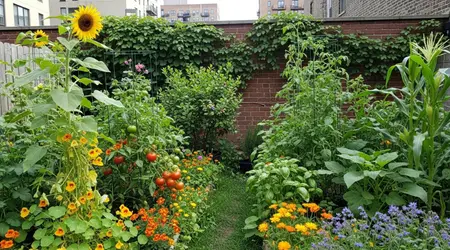
In the current 2026 season, the „Urban Three Sisters“ combination has proven particularly successful against the increasing drought in German city centers.
Here, sturdy corn stalks support the climbing beans, while large pumpkin leaves protect the sensitive soil from direct sunlight.
This Permaculture plant combinations in the city They function like a well-coordinated team, where each member compensates for the weaknesses of the others with their own strengths.
The nitrogen that the beans fix in the soil serves as a direct fertilizer for the corn, promoting strong growth.
See more: Make your own sustainable garden furniture and decorations
Why does basil protect our city tomatoes?
The intense scent of basil confuses flying pests and effectively keeps them away from the ripening tomatoes without the need for chemicals.
At the same time, the close proximity improves the aroma of the fruit and ensures better utilization of the container volume.
This partnership is like a good shared apartment where everyone supports each other and ensures a harmonious atmosphere.
While the tomato shoots upwards, the basil fills the gaps at the base of the stem and protects the soil.
See also: The best books on urban permaculture
What role do herbs play in pest control?
Strong essential oils in lavender or sage form an invisible barrier against aphids, which can often become a nuisance in stuffy courtyards.
Those who strategically plant these herbs among their cabbage vegetables significantly reduce the infestation pressure and promote the health of the entire system.
A cleverly designed urban garden does not require pesticides, as nature itself ensures the balance between beneficial and harmful organisms.
Herbs are the guardians of your harvest and also provide you with fresh spices for everyday cooking.
How do we plan for long-term resilience?
Given the extreme weather expected in 2026, urban gardeners must create systems that can withstand both heavy rainfall and weeks-long periods of drought without total failure.
Diversity is the most important insurance here: if one variety suffers from the weather, another one steps in to fill the gap.
Include perennial plants such as rhubarb or berry bushes that develop deep root systems and provide reliable yields for years to come.
Such permanent structures form the backbone of your garden and stabilize the ecological balance even in difficult times.
Why is water retention so important today?
In the city, rainwater often runs off unused, while your plants in pots wither and die of thirst, which we must actively prevent through storage solutions.
Ollas made of clay or integrated water reservoirs in raised beds release moisture slowly, thus bridging critical heat phases.
Imagine your garden as a sponge that soaks up everything when it rains and gently releases it again during dry hours.
This self-sufficiency makes you independent of daily watering intervals and at the same time conserves your city's municipal water reserves.
How do we promote pollinators in the concrete jungle?
Without bees and bumblebees there are no fruits, which is why we need flowering islands in our Permaculture plant combinations in the city must be factored into the planning.
A colorful mix of borage and marigolds ensures the pollination of your zucchini and looks fantastic on any balcony.
A garden without insects is like an orchestra without instruments; it lacks the crucial force that brings everything to life.
Create small watering holes and nesting opportunities to permanently welcome these valuable helpers into your urban ecosystem.
Urban Synergy Table 2026
| combination | Main advantage | Space requirements | difficulty |
| Tomato & Basil | Aroma protection & pest control | Small (pot) | beginner |
| Corn, beans & pumpkin | Maximum ground shading | Medium (raised bed) | Advanced |
| Strawberry & Garlic | Protection against fungal infestation | Very low | Simply |
| Carrot & onion | Carrot fly confusion | Small amount | Simply |
| Zucchini & Borage | Higher pollination rate | Medium | Medium |
| Lettuce & radishes | Quick interim use | Very low | Very simple |
| Paprika & Oregano | Heat protection through ground cover | Small amount | Medium |
| Wine & chives | Powdery mildew prevention | Vertical | Medium |
According to a recent study by Institute for Urban Agriculture 2025 Polycultural systems in cities increase resilience to heat waves by up to 40 %.
These figures impressively demonstrate that Permaculture plant combinations in the city These are not just a gimmick, but a serious strategy to secure our local food supply.
A permaculture system is like a well-functioning clockwork mechanism, where each gear meshes perfectly with the others to tell the time.
When we understand the mechanisms of nature, time works for us in the form of growing greenery and ripening fruit.
The era of sterile balconies is over; we are entering an age of edible landscapes that allow our cities to breathe.
It is an act of rebellion against the concrete jungle, to reclaim a piece of freedom with every seed we press into the earth.
In times of climate change and supply chain problems, can we really still afford to leave our urban areas unused?
Those who start today are not just planting vegetables, but cultivating the hope for a greener, more independent future for us all.
Start small, observe your plants closely and be surprised by the vitality that can arise in the smallest of spaces.
Your balcony is not a storage space, but a potential power plant of nature, just waiting for your first step.
Have you ever noticed how your plants thrive better when growing in a colorful group rather than alone? Share your experiences in the comments!
In summary, the wise choice of neighbors determines success or failure in the urban garden.
By transferring the principles of permaculture to urban spaces, we create productive ecosystems that nourish us and sustainably improve our quality of life.
Frequently Asked Questions
Do I need a large garden for permaculture?
No, the principles can be applied perfectly to balconies, terraces or even window sills, as long as you choose the right partners.
How often do I need to fertilize in a mixed crop?
The use of nitrogen fixers such as beans and organic mulch significantly reduces the need for external fertilizer compared to monoculture.
Can plants also harm each other?
Yes, some plants like fennel and tomatoes do not get along well; careful planning using companion planting charts is therefore highly recommended.
What can I do about pests on my balcony?
Use strongly scented herbs to create confusion and encourage beneficial insects like ladybugs, which will quickly find a home in a diverse system.