
Urban gardening winter harvest despite little sunlight
Advertisement
Urban gardening winter harvest ensures fresh vegetables in the middle of the cold season despite minimal sunlight on the city balcony.
Many urban gardeners mistakenly believe that their beds must lie fallow and unproductive from November onwards. However, modern cultivation methods prove the exact opposite for urban self-sufficiency.
Frost-hardy plant varieties utilize the weak winter light with high efficiency to produce important vitamins right outside your own kitchen door.
This local food production drastically reduces the ecological footprint and noticeably saves money at the same time. It simply requires a targeted selection of resilient crops.
Climate change now allows for longer growing seasons in European metropolises, which greatly benefits home cultivation.
Those who understand the biological mechanisms of hardy vegetables can harvest crisp leaves all year round. Balconies can thus be transformed into crisis-proof, green oases.
Key points
- Optimal plant selection: Focus on lamb's lettuce, kale, purslane and Asian mixed greens.
- Effective frost protection: Use of fleece, old glass bottles and insulating plant pots.
- Lighting management: Strategic placement of the boxes to maximize the use of the few hours of sunshine in winter.
What is the biological basis for vegetables in winter?
Plants do not completely cease growth in cold weather, but merely slow down their metabolism significantly.
Frost-hardy vegetables store more sugar in their plant cells, which lowers the internal freezing point like a natural antifreeze.
Have you ever wondered why kale tastes so much sweeter after the first frost?
This biochemical reaction protects the cell walls from bursting and maintains the plant's vitality.
A successful Urban gardening winter harvest is based precisely on this evolutionary adaptation of selected European and Asian leafy vegetables.
Urban gardeners make use of these natural defense mechanisms during the cold months.
A balcony in an urban area stores noticeably more residual heat than an open field due to the surrounding concrete walls of the residential buildings.
This specific microclimate creates remarkably stable conditions that ensure the survival of the plants even in freezing temperatures. The concrete structures act like a giant heat reservoir.
Scientific studies by the Bavarian State Institute for Viticulture and Horticulture confirm that Asian salads can easily survive even at minus ten degrees.
This reliable data underscores the enormous potential of urban areas for year-round food production. A large, heated conservatory is not necessary.
++ Permaculture water cycle for dry urban areas
How does photosynthesis work in diffuse light?
Winter light has an extremely high proportion of blue light and penetrates deeper into the cell structures of shade plants.
Frost-hardy vegetables possess specially optimized chloroplasts that convert even minimal amounts of light into vital energy with high efficiency. They grow more slowly, but are extremely robust.
See more: Make your own sustainable garden furniture and decorations
Why does the city protect the microclimate?
The dense urban development blocks icy winds, which would dry out the plant pots in the countryside extremely quickly.
Furthermore, the average temperature in city centers is usually two to three degrees higher than in the surrounding rural areas. Clever urban gardeners consistently exploit this advantage.
See also: The best books on urban permaculture
What role does the soil play in the winter container?
High-quality organic compost retains the limited moisture much better and protects the sensitive roots from freezing completely.
A thick layer of dry autumn leaves or coconut fibers on the soil surface provides additional insulation for the sensitive root area. This keeps the substrate active.
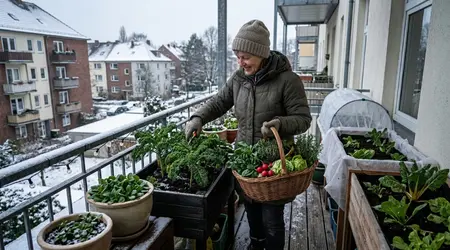
How do you optimize yield in minimal light?
The correct placement of the plant pots determines final success or total failure in winter.
A successful Urban gardening winter harvest This requires all vessels to be oriented towards the south in order to capture every single ray of sunshine.
Even a few centimeters of height difference drastically alter the amount of light reaching the balcony.
Imagine your balcony as a solar power plant that has to meticulously collect every tiny ray of light in winter.
White polystyrene panels behind the planters reflect the diffuse daylight directly back onto the green leaves. This simple method increases the light intensity by up to twenty percent.
A practical example is the cultivation of purslane, also known as common purslane, in discarded wine crates.
Purslane germinates even at a moderate two degrees Celsius and requires hardly any direct sunlight for healthy leaf growth. Such undemanding crops guarantee continuous harvests.
Furthermore, moderate watering on frost-free days prevents the plants from drying out, as cold winter air draws an extreme amount of moisture from the soil.
Many winter plants don't freeze to death, but simply die of thirst due to frozen ground. Therefore, watering should only be done at midday with lukewarm water.
Which protective covers are truly useful?
Inexpensive fleece covers or old canning jars create an effective mini-greenhouse directly above the plant, without completely blocking the sparse daylight.
This mechanical barrier keeps the humidity level stable and protects against sudden, icy snowfall. It remains simple to use in everyday life.
How do you properly harvest leafy greens in winter?
Always carefully cut off only the outer leaves of the plants, completely sparing the heart tissue in the center.
From this intact growing point, the plant produces new, fresh leaves for the next harvest within a few weeks. This ensures a constant yield.
Why is over-fertilizing dangerous in winter?
Due to their greatly reduced growth, the plants hardly absorb any nutrients, which is why excess fertilizer immediately chemically burns the roots.
From October onwards, experienced gardeners completely cease all additional fertilization to avoid disturbing the natural dormancy period. The soil remains lean.
Which plants are suitable for the cold season?
The targeted selection of varieties significantly determines the amount of vitamins you can pick in January.
A well-thought-out Urban gardening winter harvest It relies on tried-and-tested classics such as lamb's lettuce, winter chives, and extremely robust kale varieties. These plants usually withstand frost without any damage.
Another excellent example is palm kale, which visually resembles small palm trees and remains decorative even in the deepest snow.
Its leaves have a particularly mild flavor after periods of frost, as the starch they contain converts into delicious sugar. It is an ideal addition to winter cuisine.
Proper planning begins in late summer to ensure the plants develop a sufficiently strong root system before the first major cold snap. Those who sow only in November will unfortunately harvest nothing at all due to the lack of warmth during the winter. Timing is absolutely crucial.
Use vertical planting systems on the house walls, as these areas release most of the heat from the apartment to the outside.
These sheltered zones are perfect for more delicate herbs such as hardy thyme or robust sage. This makes optimal use of the available space.
Why is Asian salad gaining in popularity?
Varieties such as Mizuna or Mustard Greens grow surprisingly quickly even at extremely low temperatures and bring a pleasant spiciness to the salad.
They require very little care and can withstand even prolonged periods of frost without any lasting loss of flavor. They are perfect for beginners.
How resistant is the classic lamb's lettuce?
Lamb's lettuce survives even extreme sub-zero temperatures completely unharmed by simply pressing itself flat against the protective ground in severe frost.
As soon as the daytime temperatures rise slightly, the leaves spring back up as if by magic. It is the undisputed king of the winter balcony.
Can radishes be grown in winter?
Although special winter varieties of radishes grow significantly slower than in spring, they develop a wonderfully crisp, mild aroma under cooler conditions.
They need deeper planting containers so that the tubers can develop optimally in the loose substrate. Patience will be richly rewarded here.
Overview of the best vegetables for a winter balcony
The targeted selection of crops determines the success of your gardening efforts during the dark season.
The following table shows the most important parameters for a bountiful harvest in urban areas.
Cultivation matrix for winter balcony plants
| Vegetable type | Optimal sowing | Minimum light duration | Frost tolerance | Harvest frequency |
| Lamb's lettuce | August – September | 2 hours direct | Down to -15°C | Continuous (outer leaves only) |
| Asian salad (Mizuna) | September – October | 3 hours diffuse | Down to -10°C | Regenerates multiple times |
| purslane | September – November | 1 hour diffuse | Down to -20°C | Complete cut possible |
| Calabrian kale | June – July (Pre-culture) | 3 hours direct | Down to -12°C | Individual leaves from the bottom |
Conclusion for a year-round green paradise
A successful Urban gardening winter harvest This is by no means a utopian wishful thinking, but rather the logical result of a clever, site-adapted permaculture in urban areas.
By selectively choosing frost-resistant plants, cleverly utilizing urban microclimates, and implementing simple protective measures, you can transform any gray winter balcony into a productive oasis.
Gardening in winter sharpens our awareness of nature's natural rhythms and rewards us with maximum freshness.
Which hardy vegetables have thrived best on your balcony during the colder months? Share your personal experiences and best tips in the comments below!
Frequently Asked Questions
Do I need to water the plants daily during severe frost?
No, very little water evaporates in winter. Water only on absolutely frost-free days, and even then only very moderately around midday to avoid waterlogging.
Can I simply let regular summer lettuce continue growing in winter?
No, classic iceberg lettuce or head lettuce cannot tolerate hard frost. Their cell walls collapse immediately at sub-zero temperatures, resulting in mushy, inedible leaves.
Is there enough light on a north-facing balcony for a winter harvest?
A north-facing balcony is extremely disadvantaged in winter. Cultivated plants like purslane or lamb's lettuce grow extremely slowly there, but can still be harvested under good conditions.