
Permaculture water cycle for dry urban areas
Advertisement
A Permaculture water cycle It sustainably stabilizes dried-out urban ecosystems by systematically protecting valuable rainfall from rapid channeling into grey sewage systems.
Urban heat islands massively exacerbate the drying out of our metropolitan areas, which is why city planners now need to radically rethink their approach and implement decentralized water storage solutions.
Traditional parks consume vast amounts of external drinking water, while intelligent permaculture systems close the natural water cycle locally through clever biological design decisions.
This journalistic report analyzes functional methods to keep urban garden areas permanently productive and moist despite progressive heat waves in 2026.
Core strategies for urban water storage
- Decentralized sponge city systems: How contoured landscapes and infiltration basins efficiently slow down sudden heavy rainfall events, distribute them over a large area and store them deep in the ground.
- Biological purification biotopes: The use of specific aquatic plants for the treatment of urban greywater for direct food production.
- Vertical microclimate zones: How dense climbing plant structures reduce solar evaporation on bare concrete walls and retain valuable moisture in the system.
- Active humus formation: The targeted use of deep mulch to maximize the granular storage capacity of urban substrates.
What is meant by intelligent rainwater management in urban areas?
Anyone who has a functioning Permaculture water cycle Anyone who wants to establish this principle in asphalted metropolises must consistently stop the conventional principle of rapid water drainage.
Urban surfaces channel valuable rainwater directly into the sewer system, systematically drying out the local soil and causing the groundwater level to continuously drop.
A dry urban garden bed without well-thought-out water storage is like a leaky bucket that needs to be constantly refilled with expensive drinking water despite extreme heat.
Through strategic redesign, we capture the precipitation directly at the point of impact and gently guide it into vibrant, deep biological storage zones.
How do swales and infiltration basins work in the smallest of spaces?
Slope-parallel drainage ditches, also called swales, capture runoff surface water during heavy rain and keep it exactly on the contour lines of the terrain.
The standing water slowly seeps into the ground, filling the deeper soil layers and supplying surrounding fruit trees for weeks without additional artificial irrigation.
++ Urban gardening water shortage: Smart watering without waste
Why does vertical design protect urban gardens from extreme desiccation?
The combination of tall climbing trellises and ground-covering plant layers minimizes the direct solar radiation influence on the sensitive, living humus layer of the garden.
This layered vegetation creates a stable, humid microclimate, which drastically reduces local evapotranspiration (evaporation from plants and soil) even in the height of summer.
What measurable benefits does closing local water cycles offer?
The renowned Federal Institute for Research on Building, Urban Affairs and Spatial Development confirms that intensively vegetated open spaces can lower the local ambient temperature by up to four degrees.
This scientific fact underlines the enormous economic relevance of near-natural circular systems for the resilience of modern European cities in the current year 2026.
Furthermore, by specifically relieving the urban combined sewer system during extreme weather events, municipalities save millions of euros in infrastructure maintenance costs in the long term.
A well-thought-out Permaculture water cycle This transforms unused, hot concrete courtyards into highly productive, cooling oases with self-sufficient, crisis-proof water supply for crops.
See more: Make your own sustainable garden furniture and decorations
What parameters ensure the efficiency of urban storage systems?
The long-term success of a project depends directly on the biological filter capacity and the maximum storage volume of the substrates used.
The following table shows real, verified structural data on the water storage capacity of different ground covers under identical urban climate conditions.
Water storage capacity and evaporation protection of urban surfaces (2026)
| Type of ground cover | Maximum water storage | Cooling effect through evaporation | The need for external irrigation |
| Pure humus with deep mulch | Seventy percent | Very high | Minimal (only in extreme drought) |
| Classic lawn | Twenty percent | Small amount | High (requires daily watering) |
| Extensive roof greening | Forty-five percent | medium | Low (self-regulating moss system) |
| Open, bare topsoil | Fifteen percent | Extremely low | Very high (high risk of erosion) |
Why is the quality of urban surface water a critical factor?
Roof drains often contain fine dust and heavy metals, which is why the collected water must pass through biological filter zones before contact with vegetable plants.
Reed and gravel beds clean the incoming water purely mechanically and microbiologically, creating an absolutely safe water cycle for vegetable cultivation.
What do practical examples of urban permaculture systems look like?
A successful Permaculture water cycle It can even be implemented in very limited spaces such as roof terraces or small community gardens in Berlin-Kreuzberg.
A Berlin-based collective uses the greywater from an adjacent bakery, filters it in vertical cascades and successfully irrigates thirty productive raised beds with it.
This practical example proves that unused urban resources can generate enormous added value for local food supply through creative, biological interconnections.
Another example is a residential project in Graz that has diverted all rainwater downpipes into a connected, terraced pond system with integrated fish farming.
See also: The best books on urban permaculture
How do keyline design principles optimize moisture distribution in urban areas?
The Keyline design strategically directs water away from the wet valleys towards the dry ridges of the terrain using gentle plow lines.
This technique maximizes the usable area for cultivating demanding crops while preventing dangerous soil erosion during tropical summer thunderstorms.
What mistakes should be avoided when planning urban water storage facilities?
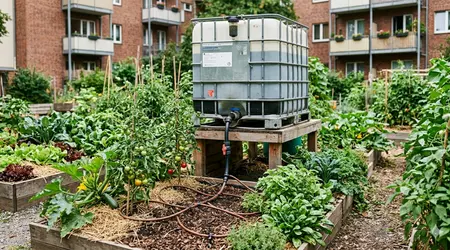
Many initiatives undersize their cisterns, resulting in valuable water overflowing unused during heavy rain and a lack of important reserves in autumn.
Accurate calculation of average local rainfall amounts protects the entire system from fatal bottlenecks during prolonged, weeks-long summer droughts.
Why do conventional irrigation methods fail in modern cities?
Do we want to continue wasting precious, intensively purified drinking water on irrigating simple ornamental lawns in our overheated cities?
The climate change-related decline in regional groundwater reserves forces us to undergo a fundamental, uncompromising paradigm shift in our daily handling of urban resources.
An optimized Permaculture water cycle replaces wasteful, shallow sprinkler irrigation with highly efficient, low-level drip irrigation systems and deep, protective mulch layers.
This consistent change protects urban greenery from drying out and at the same time noticeably reduces the strain on overloaded municipal drinking water networks.
How do Olas (clay pots) activate capillary self-watering in the root zone?
Unglazed clay pots are buried directly next to the crops and regularly refilled manually or automatically with collected, clean rainwater.
Depending on the individual degree of dryness, the surrounding soil draws moisture through the porous clay wall, completely eliminating any surface evaporation.
How does mycorrhizal fungal network strengthen the drought resistance of urban crops?
The symbiosis between specific soil fungi and plant roots increases the effective catchment area of the roots for water and nutrients many times over.
The underground fungal network stores moisture like a microscopic sponge and releases it directly to the target plants during periods of extreme heat.
Conclusion: Shaping the regenerative transformation of our cities ourselves
The establishment of closed water systems in urban areas forms the foundation for the survival of our green lungs in future hot years.
We have seen how contoured landscapes, biological filter chains, vertical evaporation protection and innovative substrates can revolutionize the urban water cycle.
The future of our metropolitan areas hinges on whether we continue to view rainwater as a danger or as a precious elixir of life.
By applying proven permaculture design principles, every urban gardener can make an active contribution to cooling and revitalizing their neighborhood.
Start optimizing your garden today and protect our planet's most valuable resource through smart action.
What creative methods for rainwater harvesting are you already successfully implementing in your garden? Share your experiences in the comments!
Frequently Asked Questions
Can collected urban rainwater be used for growing lettuce without any concerns?
Yes, provided the water has previously passed through a biological filter zone made of sand and activated carbon to reliably remove potential air pollutants.
How much space is needed at a minimum for an effective drainage trench in the backyard?
Even a small, well-planted depression two meters long can safely absorb significant amounts of surface water from a garage roof.
Which plants are best suited for the biological purification of greywater?
Marsh plants such as reeds, cattails and the yellow iris possess excellent abilities to effectively break down organic residues in water.
Does prolonged frost in winter diminish the biological function of installed Olas clay jugs?
Yes, freezing water can damage the porous clay material, which is why Olas should be completely emptied before the first winter frost.