
Edible cities concept: reality or ideal?

Advertisement
The Edible Cities Concept transforms grey concrete deserts into vibrant oases of self-sufficiency and fundamentally puts our modern urban way of life to the test.
Amid rising food prices and climate change, metropolises worldwide are looking for ways to use their green spaces productively and communally.
Imagine your daily walk doesn't take you past sterile ornamental plants, but past plump berry bushes and fragrant herb beds for everyone to enjoy.
This model is far more than a romantic utopia; it is a necessary adaptation to the resource scarcity of our time.
Key aspects of urban transformation
- Philosophy: The return of food production to the direct living environment of citizens.
- Practice: Use of parks, facades and roofs for growing vegetables and fruit.
- Social: Strengthening community spirit through gardening and harvesting together.
- Ecology: Promoting biodiversity and improving the urban climate through targeted permaculture.
What makes an edible city?
The Edible Cities Concept It is based on the idea of systematically planting useful plants in public green spaces, instead of just maintaining decorative lawns.
Municipalities like Andernach in Germany have already proven that kohlrabi instead of pansies not only satisfies hunger but also reduces administrative costs.
The implementation resembles a living organism, in which every citizen becomes a part-time farmer and takes responsibility for their local environment.
The aim is to eliminate the distance between production and consumption and to solidify knowledge about natural cycles in urban areas.
How does the practical design work?
In the design, planners rely on permaculture principles to create resilient ecosystems that thrive without chemical fertilizers and with minimal water consumption.
Fruit trees provide shade, while perennial vegetables cover the ground, effectively retaining moisture in the soil.
Cities are using vertical gardens on school buildings or town halls to produce an impressive variety of food even in the smallest of spaces.
These green lungs filter fine dust and noticeably cool the surrounding air in increasingly hot summers.
++ Urban garden pest control completely without chemicals
What advantages does this model offer?
A key advantage is social inclusion, as access to fresh food is made possible regardless of the residents' financial means.
Community gardens become social melting pots where people of different backgrounds come together through their shared interest in gardening.
Furthermore, local harvesting massively reduces CO2 emissions, as long transport routes and elaborate packaging for the vegetables are completely eliminated.
Will we only be getting our salads from balconies or city parks in the future?
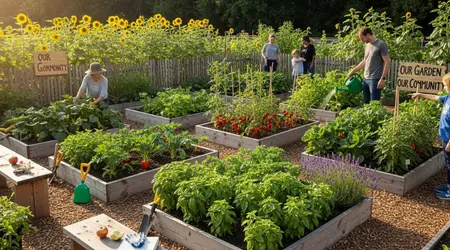
Is the implementation really realistic?
Despite the enthusiasm, the Edible Cities Concept facing bureaucratic hurdles, as liability issues in cases of contamination or vandalism often remain unresolved.
Many city administrations fear the increased maintenance costs, although studies show that citizen initiatives often take on these tasks on a voluntary basis and with great care.
Reality shows that a patchwork of private gardens and public projects alone is not enough to fully feed a city of millions.
Nevertheless, these projects act as important catalysts for a new awareness in the handling of valuable urban land resources.
According to a study by the University of Applied Sciences South Westphalia, urban gardening may not be able to secure the entire calorie supply, but it can cover up to 30% of the fresh vegetable needs.
This figure illustrates that the concept represents a serious pillar of urban resilience, provided it is professionally planned.
A comparison with an operating system is obvious: The city provides the hardware, while the citizens supply the software in the form of engagement.
Without the active participation of local residents, even the best-intentioned green planning remains a lifeless shell without lasting success.
See more: Micro-gardens in the kitchen: Fresh herbs always at hand
Why do some projects fail?
Often, there is a lack of long-term financing for the initial infrastructure, such as water connections or guaranteed soil quality in contaminated urban areas.
When communication between authorities and citizens breaks down, the flowerbeds quickly become neglected and the ideal image develops unsightly cracks.
Another factor is soil sealing, which often makes direct cultivation in the ground impossible and necessitates expensive raised bed systems.
Only through innovative solutions and political backing can these physical barriers be permanently overcome and yields stabilized.
See also: How you can store CO₂ with your garden
What does the financing look like?
Successful cities finance this Edible Cities Concept through a reallocation of budgets for traditional green space maintenance and through targeted funding.
Sponsorship models with local companies also help to spread the costs for seeds and tools among several people and to strengthen identification.
Some municipalities are integrating the gardens into educational programs, which can generate additional funds from the education sector for the upkeep of the facilities.
This creates an economic cycle that ensures the continued existence of edible landscapes even in economically difficult times.
What role does permaculture play?
Within urban planning, permaculture enables a design that regulates itself and reduces human intervention to a minimum.
By cleverly combining plants, as in the "Three Sisters" system (corn, beans, pumpkin), nutrients are used optimally.
This knowledge is the backbone so that the Edible Cities Concept so that it doesn't fail miserably due to staff shortages during the summer holiday season.
Natural cycles ensure that pests are controlled by beneficial insects and that the soil remains fertile through mulching.
A forest garden in the middle of the city is the ultimate answer to the question of sustainable aesthetics and high utility.
Such systems require hardly any maintenance after the establishment phase and provide reliable harvests for the neighborhood for decades.
Permaculture is not a hobby, but an applied science for maximizing the ecological and social return on urban areas.
It is the art of working with nature instead of fighting against it.
What are the best plants?
Fruit trees and berry bushes are particularly suitable, as once planted they provide yields for years and require little ongoing attention.
Herbs such as rosemary or thyme are extremely resistant to heat and drought, making them ideal candidates for the roadside.
Old varieties are experiencing a renaissance, as they are often more robust against local diseases than highly bred hybrids from the garden center.
The diversity on the plate begins with the diversity in the garden bed, which is specifically promoted through seed libraries in cities.
How is the harvest distributed?
The principle of "harvest for all" relies on social control and fairness, which works surprisingly well in most projects.
Information boards explain the ripeness of the fruit to prevent unripe fruit from being picked and valuable resources from being lost.
In some cities there are digital apps that show where which fruits are currently available for harvesting in public spaces.
This promotes the mobility of citizens and combines digital innovation with a pristine nature experience in the immediate living environment.
Data comparison: Urban gardening over time
| factor | Traditional green space | Edible City (Permaculture) |
| Care effort | High (mowing, fertilizing) | Low (after establishment) |
| biodiversity | Low (monocultures) | Very high (mixed crops) |
| Benefits for citizens | Passive relaxation | Nutrition & Community |
| Water efficiency | Small amount | High (due to mulch layers) |
| Costs (long-term) | Consistently high | Decreasing due to self-care |
The Edible Cities Concept is far more than just a trend; it is the answer to the longing for autonomy in a complex world.
We transform consumers back into producers and create meeting places that go far beyond mere gardening.
While urban agriculture will not replace global trade, it makes our centers more resilient, cooler, and more livable.
Every raised bed planted is a statement for a greener future and against the sterile monotony of modern architecture.
Ultimately, our willingness to cooperate will determine whether this vision remains a lasting reality.
How are you experiencing the greening of your city? Are you already seeing the first signs of edible plants in your neighborhood? Share your experiences in the comments!
Frequently Asked Questions
Isn't the fruit from the road contaminated by exhaust fumes?
Studies show that the pollution caused by thorough washing is usually negligible, as fine dust hardly penetrates the interior of the fruit.
Nevertheless, busy main roads should be avoided for growing leafy vegetables.
Who is allowed to harvest in an edible city?
In principle, harvesting in public spaces is permitted for everyone, as long as you only take as much as you can consume yourself.
The concept is based on mutual respect and the sharing of resources within the city's society.
How can I start my own project?
The first step usually leads to the city's green spaces department to apply for a sponsorship of an area or to start an initiative.
Often there are already existing networks for urban gardening that one can easily join.
What happens in cases of vandalism?
Experience shows that areas maintained collectively are significantly less likely to fall victim to vandalism than anonymous green spaces.
Social control and the identification of residents with "their" flowerbeds effectively protect the plants.