
Edible micro-areas in the city: Maximum harvest on 2 m²
Advertisement
Edible micro-areas in the city In 2026, they will transform dreary balconies and tiny windowsills into highly productive oases that will fundamentally change and enrich our daily diet.
Many city dwellers mistakenly believe that huge plots of land are needed for true self-sufficiency, but the reality of modern permaculture proves the opposite today.
Innovative cultivation methods allow us to produce an amazing variety of nutrients even on an area of just two square meters.
These green cells in the concrete jungle not only lower our food costs, but also noticeably and sustainably improve the microclimate of our overheated homes.
Guide to urban self-sufficiency
- Vertical gardening: Utilizing height through modular wall pockets and hanging planters.
- Mixed cropping principle: Optimally utilize synergies between different plant species in a very small space.
- Smart irrigation: Autonomous water storage systems that minimize maintenance costs in the city.
- High-yielding varieties: Focus on fast-growing microgreens and space-saving dwarf varieties for balconies.
How can maximum productivity be achieved in a small space?
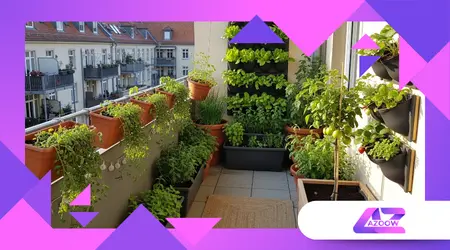
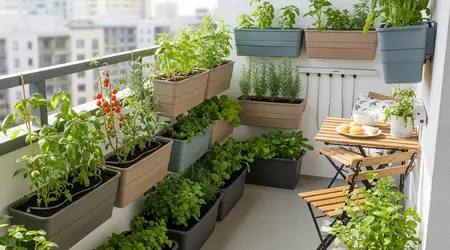
The concept of Edible micro-areas in the city is based on the radical exploitation of the third dimension by understanding walls and railings as active growing surfaces.
Instead of using only horizontal pots, we stack planting levels on top of each other, which visually and functionally multiplies the available area.
An intelligent layered structure ensures that heavy feeders like tomatoes grow on top, while herbs and salads thrive in their shade and cover the ground.
This arrangement protects the earth from drying out and utilizes every available photon of urban sunlight for plant growth.
Why is the choice of variety crucial?
Modern breeding programs now focus on "balcony giants" that, despite their compact growth, can deliver enormous yields of fruit or leaves.
By using seeds that have been specially optimized for container cultivation, we avoid unnecessary root growth and promote fruit formation.
Those who farm on two square meters should focus on plants that continuously regrow, such as loose-leaf lettuce or perennial cabbage.
This guarantees a continuous harvest throughout the entire season, instead of waiting for just one harvest time per year.
++ Urban Farming Trends 2026: New Ways of Urban Production
How can the nutrient cycle be optimized?
By 2026, urban permaculture will increasingly use Bokashi buckets to transform kitchen waste directly in the home into high-quality liquid fertilizer and fermented soil.
This closed cycle eliminates the need for expensive purchases of chemical fertilizers and promotes healthy soil life in a very small space.
By returning organic residues to the Edible micro-areas in the city Soil fertility remains stable, which is particularly vital for survival in small containers.
Healthy soil acts like an immune system for plants against urban pests and stressors.
What are the advantages of harvesting directly in front of the window?
Consuming food that has not been transported a single mile guarantees a nutrient density that no supermarket product can ever achieve.
Harvesting herbs just before cooking preserves all the essential oils and vitamins, dramatically improving the flavor.
In addition, the Edible micro-areas in the city as a psychological anchor in stressful everyday life, since caring for the plants has a meditative effect.
The daily observation of growth reconnects us with the natural rhythms that are often lost in the big city.
See more: Make your own sustainable garden furniture and decorations
How does greenery affect air quality?
Plants on the balcony act like natural filters, binding fine dust and lowering the temperature in the apartment through evaporation.
In hot summers, a densely vegetated micro-area can cool the ambient temperature by up to three degrees Celsius.
This cooling effect is like a natural air conditioner that does not consume energy, but instead produces food and provides oxygen.
Who would have thought that a few tomato plants could so massively increase living comfort while simultaneously purifying the air?
See also: Urban Farming vs. Urban Gardening: What is the difference?
Why is the social component important?
Visible gardens on facades promote exchange between neighbors and inspire other residents to also become part of the edible city movement.
Often, the exchange of seedlings or surplus harvest creates new communities that strengthen social cohesion in the neighborhood.
The balcony thus becomes a showcase of a sustainable lifestyle, demonstrating that every individual can make a contribution.
This form of gentle activation is the driving force behind the transformation of our cities into green, livable and productive habitats.
Why is urban permaculture the future of urban planning?
Given rising prices for logistics and space, the Edible micro-areas in the city to an economic necessity for the urban middle class.
The current study by the Institute for Urban Ecology (2025) shows that residents with micro-areas can save up to 15 percent of their vegetable costs.
Urban planners now routinely integrate planting modules into new housing projects to increase citizens' autonomy and promote biodiversity.
This transformation from ornamental plant to useful plant is a clear sign of a new awareness in the world of architecture.
What is the principle of stacking?
Nature works in different layers in the forest, from the ground to the crown, and we transfer this exact principle to the balcony.
Climbing plants like beans use the railing, while root vegetables grow in deep boxes below and herbs occupy the edges.
These analogies to the forest garden make it possible to raise biomass production per square meter to a level that far surpasses conventional garden beds.
We are not practicing agriculture here, but rather highly precise resource management on a biological basis, making sensible use of every millimeter.
What will the smart garden look like in 2026?
Sensors now monitor soil moisture via app and, if necessary, control solar-powered pumps that distribute rainwater from small storage tanks.
The Edible micro-areas in the city This makes it a low-maintenance system that thrives even when the residents are absent.
Technology and nature merge here into a unified whole, making it easier than ever for beginners to get started.
Will we even need supermarkets for fresh greens in the future if every wall becomes a productive source?
Comparison: Classic balcony vs. edible micro-area
| feature | Classic geranium balcony | Edible micro-areas in the city | Benefits for residents |
| Purpose | Purely decorative | Food & Climate Protection | Added value per m² |
| Water consumption | High (evaporator) | Efficient (storage/mulch) | Resource conservation |
| Yield | None | Up to 25 kg of vegetables per year | Financial relief |
| biodiversity | Small amount | High (nectar & pollen) | Support for insects |
| Care effort | Manually | Smart/Automated | Time saving |
The green evolution of your own four walls
The analysis clearly shows that the Edible micro-areas in the city far more than a short-term trend; it is a vital adaptation to urban life.
We have learned how vertical layering and smart variety selection can transform even the smallest spaces into productive centers.
This development gives us back control over our food and makes us less dependent on global supply chains and price increases.
By transforming our windowsills into gardens, we not only heal the city, but also our relationship with nature.
Start today with a single pot and experience how your two square meters become the most important room in your home.
Have you ever tried growing your own vegetables in a very small space, or does the amount of work involved still put you off? Share your experiences in the comments!
Frequently Asked Questions (FAQ)
Is it really possible to grow vegetables without a direct garden?
Yes, many varieties thrive in pots, provided they receive enough light and the right nutrients.
Vertical systems make optimal use of walls, so that even a French balcony can become a... Edible micro-areas in the city can be.
Is there enough light in narrow city canyons?
For shady spots, there are specialized plants such as spinach, arugula, or certain herbs that require less sun.
In extremely dark locations, energy-saving LED grow lights can provide the necessary growth spectrum to ensure a good yield.
How do you prevent waterlogging in small containers?
Good drainage using expanded clay at the bottom of the pot is essential to protect the roots from rot.
Modern pots often have integrated reservoirs that store water and release it to the soil via capillary action when needed.
How much time do I need to invest weekly?
With automated irrigation systems, the effort is reduced to about 15 to 30 minutes per week for harvesting and monitoring.
It is a hobby that can be perfectly integrated into a busy professional life while also providing relaxation.
Are the proceeds from the city safe from a health perspective?
Because you have control over the soil and fertilizer, your vegetables are often less polluted than industrially produced goods from the store.
In busy streets, you should simply make sure to thoroughly wash the harvest before eating it to remove any fine dust.