
Donate or recycle old clothes? Here's how to do it right.

Advertisement
Donate or recycle old clothes It's a decision we all face when our wardrobes are bursting at the seams and we want to make room for new things.
Sustainable consumption does not end with the purchase, but requires a conscious responsibility for the entire life cycle of our textiles, so that they do not end up unnecessarily in waste incineration.
We live in a time when almost every German household sorts out several kilograms of clothing every year without knowing exactly where it will ultimately end up.
It is time to shed light on the darkness of the textile market, because our actions determine the future of valuable resources and the relief of our environment.
- The separation between donation and disposal
- The ecological importance of the textile cycle
- Strategies for a sustainable wardrobe
Why is donating or recycling old clothes more important today than ever before?
The impact on the global market
Many people think that Donate or recycle old clothes "Automatically" means that these items directly help those in need or are immediately recycled, but unfortunately, reality has become much more complex.
The market for second-hand fashion is extremely saturated due to the massive influx of fast-fashion items, which has drastically reduced the value of donated clothing.
Our donations often end up in countries of the Global South, where they put pressure on local textile markets and pose existential problems for local tailors.
We therefore need to examine much more critically which items of clothing actually deserve a second chance and which should simply be considered waste.
The environmental impact of textile waste
The textile industry produces millions of tons of waste annually, a large proportion of which never undergoes genuine recycling but ends up directly in landfills or is incinerated.
If we ask ourselves whether Donate or recycle old clothes To determine the better option, we must primarily consider the quality of the fibers used.
Mixed fabrics made of polyester and cotton are currently difficult to separate efficiently using modern technology, making recycling a huge challenge for modern plants.
Therefore, the following applies: avoidance before reuse and reuse before the final recycling process, in order to keep the ecological footprint of our clothing as small as possible.
++ Your first Fair Fashion month: A challenge for your wardrobe
Strategies for responsible sorting
Before you visit the next used clothing container, you should honestly assess the condition of your items, because only high-quality clothing finds a new user.
Repair minor defects yourself or specifically look for local organizations that have a real need for specific types of clothing.
By curating your selection, you prevent professional sorting facilities from being overloaded with worthless waste that they have to process under intense time pressure.
Consider your clothing as a valuable raw material that should retain its usefulness for as long as possible, instead of simply disposing of it anonymously.
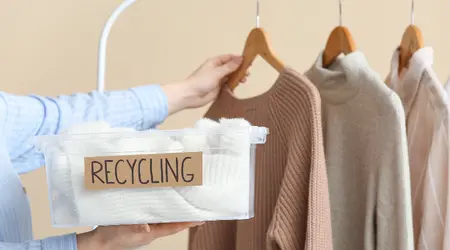
How does the correct process of donating or recycling used clothing work?
Choosing the right collection point
If you are interested in the Donate or recycle old clothes When making your decision, be sure to look for the Fair Value seal or reputable certifications of the waste disposal organizations.
Reputable providers will inform you about how the proceeds from clothing recycling are used and whether social projects in your region can benefit from it.
Avoid dubious containers without a company address, as these often serve commercial purposes where your clothing is simply sold for profit as cleaning rags or insulation material.
Transparency is the most important criterion when deciding to whom you ultimately want to entrust your carefully sorted textiles.
See more: Sustainable swimwear: Swimming in an environmentally friendly way
When is a garment only suitable for recycling?
A garment has reached the end of its life when it has become simply unusable due to wear and tear, stains, or irreparable rips.
In this case, recycling is the last logical step so that the fibers can at least find a new use in industrial processes.
Think of the analogy of a discarded book: you don't put a tattered, unreadable book in the library, but rather in the waste paper recycling.
The same applies to textiles that have lost their integrity and whose repair would far exceed the value of the object.
See also: What do GOTS, OEKO-TEX & Co. mean? Sustainability labels explained.
The role of professional textile recycling
Modern sorting facilities now use intelligent sensors to identify fiber types, which significantly speeds up the process of separating cotton, wool and synthetics.
By correctly pre-sorting your clothing before you hand it over, you significantly simplify this complex technical process and contribute to greater efficiency.
According to the German Federal Association for Secondary Raw Materials and Waste Management, approximately 1.3 million tons of used textiles are collected annually in Germany, but only a fraction of these are recycled as high-quality new goods.
Do you actually know how many kilometers the fiber of your old jeans has already traveled before it reaches the trash?
What are the benefits of donating or recycling old clothes for the future?
Circular economy instead of throwaway mentality
By consistently distinguishing Donate or recycle old clothes By choosing this option, we are making an active contribution to the vision of a circular economy, in which waste is seen as a resource.
Sustainable fashion consumption requires that we no longer view and care for our clothing as short-lived disposable products, but as durable everyday items.
Every item we wear longer through proper care saves valuable liters of water and chemical fertilizers that would be needed to produce new fibers.
If we collectively focus on quality rather than quantity, the need for new resources decreases, noticeably relieving the pressure on our planetary boundaries.
The importance of material composition
The future lies in the development of textiles made from a single type of material, enabling genuine "fiber-to-fiber recycling" instead of just offering a downcycling option for inferior products.
Manufacturers have a responsibility to create durable designs that can be efficiently recycled even after years of use.
By making conscious purchasing decisions today, we give manufacturers the necessary signal to invest in more sustainable materials and fair production conditions.
Our daily choice when dressing is therefore a political decision that can shape the entire global market for sustainable fashion in the long term.
Summary of decision aids
Here you will find an overview to help you make the right decision for your textiles during your next decluttering session and to avoid waste.
| Condition of clothing | Recommended action | Why? |
| Like new / Unworn | Sell or trade | The highest value is retained. |
| Well preserved / Used | Legitimate donation | Direct social support |
| Slightly damaged | Repair (upcycling) | Resources are conserved. |
| Heavily worn | Textile recycling | Fibers are used for insulation. |
Conclusion: Take responsibility for your wardrobe
In summary, it can be said that Donate or recycle old clothes It is far more than just separating waste; it is an active decision for greater ecological integrity.
We must understand that every donation has an impact and every disposal represents a conscious choice between waste and valuable raw material.
By valuing, caring for, and ultimately passing on our clothing responsibly, we close the circle and preserve valuable resources for future generations.
Have you ever tried repairing your old clothes instead of simply giving them away?
Share your experiences in the comments and inspire others to design their own wardrobe more consciously.
Frequently Asked Questions
Can I throw clothes with holes into the used clothing container?
Yes, provided it is clean and dry, it can often still be recycled as a raw material for cleaning rags or insulation material.
Are private clothing bazaars better than used clothing containers?
Often yes, because the clothing goes directly into a new use cycle without long transport routes or anonymous sorting processes.
What happens to clothes that nobody wants to buy anymore?
It is often exported, thermally recycled, or processed into inferior products such as industrial fleece if no recycling is possible.
What should I look for in a reputable aid organization?
Look for transparent reports on the whereabouts of the clothing and the use of the proceeds for social purposes.
How can I tell if a container is for commercial use?
Commercial containers are often not marked as "non-profit" and primarily serve to maximize profits through the sale of used textiles.