
How to reevaluate the value of things – with the 90-day rule

Advertisement
How to reevaluate the value of things with the 90-day rule is a key question for anyone who wants to successfully integrate minimalism into their life.
This simple yet profound method provides a clear framework for breaking through emotional attachment and making truly more conscious decisions about our property.
As an experienced columnist, I can confirm: The power of the 90-day rule lies in its psychological accuracy.
The truth is that most of our possessions provide only short-term gratification, often as an impulsive response to advertising or stress.
This rule forces us to overcome the emotional, knee-jerk reaction and critically examine the true, long-term benefits of an object. It is a pragmatic tool for profound change.
What is the psychology behind the 90-day rule?
The psychological basis for the Re-evaluate the value of things with the 90-day rule lies in overcoming the so-called ownership effect.
This effect describes our tendency to value things we own more than things we don't. This emotional bias is deeply embedded in our brain.
If we don't use an item for 90 days, the initial emotional attachment triggered by the buying frenzy fades.
The rule creates a crucial distance that allows for a rational reassessment of utility. It replaces emotional attachment with functional necessity as the primary decision criterion.
++ Minimalist gifts: Give joy without excess
The power of habit formation
90 days represents a significant period of time, often cited in psychology as a benchmark for establishing new habits.
If we manage to ignore an object for this length of time, the habit of living without it manifests itself. We have learned to fulfill the required function differently or not at all.
This process of habituation is crucial. The absence of the object becomes the new normal, significantly lowering the pain threshold of "loss."
After 90 days, decluttering no longer feels like a sacrifice, but rather a logical, liberating consequence.
See more: How I regained my creativity through digital decluttering
Why 90 days and not 30 or 60?
The 90-day duration is more than arbitrary; it captures most seasonal and short-cycle usage needs.
While 30 days is enough to make impulse purchases regrettable, 90 days covers longer activity cycles. It takes into account, for example, hobbies that are only practiced once a quarter or specialized tools.
By providing a longer buffer, the rule prevents hasty decisions about potentially useful but rarely used items.
It ensures that we don't create a long-term deficiency out of short-term tidying, which would harm minimalism in the long run.
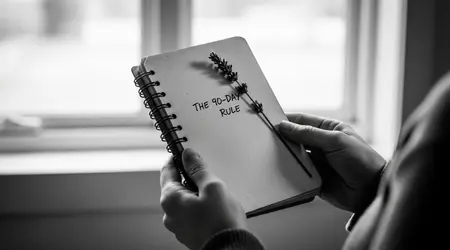
How do I implement the 90-day rule in practice?
The implementation of the Re-evaluate the value of things with the 90-day rule is simple and does not require complicated organizational systems.
It begins with a single, clear step: physically removing the object from your everyday field of vision. This must be done consistently.
Create a “90-day box” or a dedicated, inconspicuous storage location (e.g., a corner of the basement or attic).
Any item you're unsure about whether you really need goes into this box. Important: The box must be locked and removed from sight to minimize temptation.
See also: Why minimalist travel creates deeper memories
Documentation as a success factor
Keep a simple log, either digitally or directly on the box. Note the date the box was closed.
If, after the 90 days, you realize you haven't removed a single item from the box, your decision has been made. You don't need those things.
If you do need an item, take it out and note the date you removed it.
Only items that remain untouched by the end of the deadline will be donated or sold. This documentation makes the process transparent and proves the lack of need.
Dealing with emotional objects
The emotional hurdle is especially high when it comes to heirlooms or gifts. The 90-day rule can help here, too: Store the item, but take a high-quality photo of it first.
The photo retains the memory while the physical object is put aside.
Many people report that the memory of their loved one often remains more present through the photo than through the dusty object itself.
After 90 days, the emotional attachment to the object reduced, while the Memory remains intact.
What are the benefits of consistent use?
The consistent application of Re-evaluate the value of things with the 90-day rule leads to measurable benefits that go far beyond decluttering.
It's a training for more conscious consumption and an increase in overall well-being. The greatest benefit is mental space.
By getting rid of unnecessary possessions, we automatically reduce the stress that comes with clutter and managing belongings.
We create clarity and reduce the cognitive load caused by every single object in our home.
Financial discipline and savings
The rule also acts as a preventative measure against future impulse purchases. Once you've gone through the process and realized how many items end up in the box, you'll automatically be more critical about your next purchase.
You learn to evaluate the value of things not immediately, but with a delay.
Studies on consumer behavior show that Over 60% of consumers regret a purchase at least once a year, with clothing and decoration being the most common categories.
The 90-day rule is a direct counter to this consumer remorse and promotes financial discipline through critical delay.
The rent for the storage space
Imagine if every object in your home had to pay a daily rent—not in money, but in your attention, your time spent caring for it, and the space it occupies.
The items that remain untouched in the box after 90 days are paying rent without providing any benefit. Would you renew such a contract?
This mental reversal immediately reveals the unnecessary baggage. The rent these items pay in the form of your life energy is too high. The 90-day rule helps you terminate these unnecessary leases.
Why is the 90-day rule an indicator of true value?
The Re-evaluate the value of things with the 90-day rule provides an incorruptible measurement of true use value.
An item that hasn't been used for 90 days isn't essential to your life in its current form. True value lies in its use, not in its ownership.
This rule teaches us to distinguish between intrinsic (functional) value and extrinsic (social or emotional) value.
An unused designer piece has high extrinsic value, but zero intrinsic value when it is in the box.
The focus on experience rather than possessions
Minimalism teaches us that experiences and interpersonal relationships provide a higher and longer-lasting happiness value than material goods.
By letting go of things, we create time and financial resources for experiences. So, the rule doesn't just focus on things, but on our priorities.
An unused item in the box means that the associated resources (money, time, mental capacity) would have been better used for an activity or experience.
After 90 days, this abuse of resources becomes painfully clear.
| Category of the object | Psychological value (90 days ago) | True value (after 90 days) |
| Impulse purchase (item of clothing) | Emotional high, social status | Functionality: Zero if unused |
| Old hobby equipment | Nostalgia, potential for the future | Load: Must be stored and maintained |
| Heirloom without function | Sentimental value, sense of duty | Reminder: Remains in the photo |
| Result of the 90-day rule | Often biased by the ownership effect | Objective benefit = 0 if untouched |
The Re-evaluate the value of things with the 90-day rule is not just a decluttering method, but a powerful tool for self-reflection.
It forces us to accept the unvarnished truth about our consumption and to measure the actual utility of our possessions.
The 90 days of clarity gained are worth more than any material object. Minimalism isn't a sacrifice, but rather a gain in freedom and focus.
Ready to finally say goodbye to emotional baggage? Share your experiences with the 90-Day Rule in the comments!
Frequently Asked Questions
What do I do if I need an item shortly after 90 days?
That's not failure! Take the item and use it. Mark the date you took it.
The rule states that only untouched Items are discarded. The exception proves that the item has real utility value.
Can I apply the 90-day rule to digital items as well?
Absolutely. The method is excellent for re-evaluating the value of digital subscriptions, apps, or unused files.
Cancel your subscription or deactivate the app for 90 days. If you don't miss it, the value will be zero.
How do I handle things I need seasonally (e.g. ski equipment)?
Seasonal items are natural exceptions. Evaluate them when their season is over. This rule is intended for items that theoretically could be used at any time, but remain unused.
Is there an alternative method to start minimalism?
Yes, the “KonMari method” (according to Marie Kondo) focuses on keeping only the things that “spark joy.”
The 90-day rule, on the other hand, focuses on the To use and is therefore more functional and less emotional.