
Permaculture and social justice: How are they connected?
Advertisement
Permaculture and social justice are inextricably linked. Many mistakenly view permaculture as merely a gardening method.
They overlook the ethical foundations of the concept. The founders, Bill Mollison and David Holmgren, were radical.
They designed a system that would ensure ecological stability and ensures human well-being.
In 2025, this connection is more important than ever. In the face of climate change, food deserts, and growing inequality, it is revolutionary.
Permaculture is not just one answer to that, What we cultivate. It is an answer to that, How we live together.
This article examines the deep social roots of a supposedly ecological concept.
What is the core of permaculture ethics?
The essence of permaculture is often reduced to Earth Care. However, that's only a third of the story. The social dimension is equally fundamental and firmly embedded in the system.
Permaculture is incomplete without the ethics of "People Care" and "Fair Share".
It is this ethic that Permaculture and social justice directly linked together.
++ Collecting rainwater: Tips for sustainable irrigation
Why is "People Care" so important?
“People Care” begins with ourselves, but extends to the community. It is the recognition that we cannot build healthy ecosystems without healthy societies.
This is a direct mandate for social justice. It calls for the removal of barriers. It demands access to clean resources, healthy food, and decent work for all.
See more: Micro-gardens in the kitchen: Fresh herbs always at hand
What does Fair Share mean in practice?
"Fair Share" is the most radical ethic of permaculture. It demands the equitable distribution of surpluses. This directly challenges capitalism and overconsumption.
This ethic acknowledges that the planet's resources are finite. It demands that we limit our consumption. Surpluses should flow to where they are most urgently needed.
How does permaculture combat systemic inequality?
Permaculture offers practical tools to combat systemic inequality at the local level. It focuses on food sovereignty and building local, resilient economic systems.
It empowers people to regain control over their basic needs. This is a powerful political statement in a globalized world.
See also: How you can store CO₂ with your garden
What are "food deserts" and how does permaculture help?
"Food deserts" are urban areas without access to fresh, healthy food. Marginalized communities are often affected.
A study by the Thünen Institute clearly shows that access to healthy food depends heavily on socioeconomic status.
Urban permaculture projects break down these structures. They create local food sources in backyards, on roofs, or on fallow land.
This is an act of food sovereignty. Permaculture and social justice This means regaining control over one's own food.
How does permaculture promote economic self-determination?
Permaculture designs local, resilient economic systems. A key example is Community Supported Agriculture (CSA), also known as solidarity-based agriculture.
Members share the harvest and risk with the producers. This stabilizes the farmer's income and the community's food supply.
This massively strengthens the local economy. It makes communities less dependent on fragile global supply chains.
Initiatives like "Community Supported Agriculture" (CSA) create fair jobs. They offer wages outside the often exploitative agricultural system.
What role does permaculture play in urban resilience?
In cities, the centers of inequality, permaculture unfolds a special social power. It uses neglected spaces to create ecological and social wealth.
Urban gardens are becoming hubs for Permaculture and social justiceThey are more than just places where vegetables grow.
How do urban gardens create social spaces?
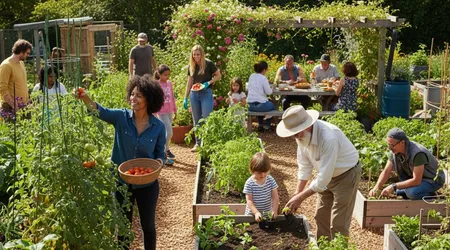
Urban gardens are important social meeting places. They promote integration and break down barriers between generations and cultures.
In anonymous cities, they offer a place of belonging. Here, isolation is broken down and community is actively lived.
The "Princess Gardens" project in Berlin (now "Collective Gardens") transformed a wasteland into a thriving social hub.
Permaculture and social justice These principles are put into practice here. It is a place of learning for democracy, participation, and ecological awareness.
Why is land access a social issue?
The question of who owns land is one of the oldest social questions. Historically, land has often been distributed unequally through violence or laws.
The lack of access to land perpetuates poverty. It prevents communities from building their own resources.
Permaculture poses this question anew. Projects like "guerrilla gardening" are political acts. They reclaim public land for the common good.
Community land trusts are another tool. They secure land permanently for the community, removing it from pure market speculation.
What are the challenges and criticisms?
Despite its radical potential, the permaculture movement faces major challenges. It must confront the criticism of often being elitist and apolitical.
The connection of Permaculture and social justice It must be actively fought for. It cannot remain mere lip service.
Is permaculture accessible to everyone?
This is a valid criticism. Permaculture Design Courses (PDCs) are often expensive. They cost hundreds or thousands of euros.
They often attract a white, educated, middle-class audience. This contradicts their own claim of universal applicability.
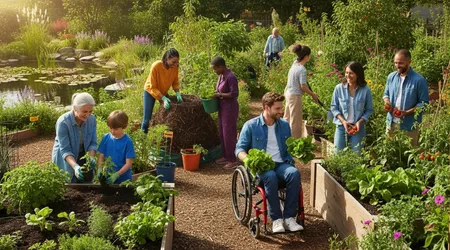
The movement must actively promote inclusion. Knowledge must be freely shared, not exclusively commercialized.
Permaculture and social justice This requires dismantling these elitist barriers. We need more free, local knowledge transfer and decolonial approaches.
How do we bridge the gap between theory and practice?
The "fair share" ethic is the hardest to implement. We live in a system that rewards hoarding, not sharing.
A beautiful garden alone won't change the global system. Permaculture must not degenerate into mere self-optimization in the private sphere.
It must be political and networked. It must ally itself with movements for land reform, climate justice, and anti-racism.
Permaculture and social justice This requires systemic change. An individual, conscious lifestyle is not enough.
Comparison: Industrial vs. Permaculture Systems
| feature | Industrial agriculture | Permaculture (Social Focus) |
| Goal | Profit maximization, efficiency | Resilience, well-being (ecological & social) |
| control | Centralized (corporations) | Decentralized (community) |
| Access | Dependence on supermarkets | Food sovereignty (local production) |
| Work | Often precarious, exploitative | Fair wages, meaningful work |
| excess | Becomes a commodity (speculation) | Will be redistributed (Fair Share) |
Conclusion: The political aspect of the garden
The analysis shows that permaculture is deeply political. It is not an escape from the world. It is a blueprint for a better, more just world.
The connection of Permaculture and social justice That's the core issue. Without "People Care" and "Fair Share," it remains merely an optimized gardening technique. It misses its mark.
Urban gardens and CSA projects are real-world laboratories. They prove that another world is possible. A world that honors both humanity and nature.
The challenges are real, especially those of inclusion. But the principles offer a clear compass for actively combating injustice.
An industrial system is like a pipeline: efficient but rigid, centralized, and prone to leaks. Permaculture is like a watershed: an interconnected, decentralized, resilient system that feeds many and fosters life.
The principles of permaculture are radical. They challenge us not only to garden differently, but to live and do business fundamentally differently.
The crucial question remains: Are we truly ready to take "fair share" seriously and redistribute power, privileges, and resources?
By we Permaculture and social justice By thinking together, we plant the seeds for a truly livable future. It's not just about gardens, it's about justice.
Share your experiences: Where do you see the strongest connection between gardens and justice in your city? Discuss it with us in the comments!
Frequently Asked Questions
What are the three ethical principles of permaculture?
The three ethical principles are: “Earth Care”, “People Care”, and “Fair Share” (often also interpreted as “limiting consumption and population”).
How can I use permaculture for social justice without having a garden?
Permaculture and social justice This is also reflected in consumption. Support local, community-supported agriculture (CSA) farms.
Get involved in food sharing initiatives. Or use permaculture design principles to organize social projects in your neighborhood.
Is "guerrilla gardening" legal?
No, “guerrilla gardening” (planting on someone else’s or public land without permission) is usually a legal gray area or illegal (property damage or trespassing).
However, it is often a conscious act of civil disobedience to draw attention to land scarcity and “food deserts”.
Why is permaculture criticized as "elitist"?
The criticism often arises because of the high costs of certified Permaculture Design Courses (PDC).
These courses are often the entry ticket into the community, but unaffordable for people with low incomes. This creates a social barrier that contradicts the principle of "people care".
What does "food sovereignty" mean?
Food sovereignty is the right of all people to healthy and culturally appropriate food.
More importantly, it is the right to determine one's own agricultural and food systems, independent of global corporate interests.