
Material hype 2026: What is really better – hemp, Tencel or recycled polyester?
Advertisement
Material Hype 2026 Redefining the way we evaluate textiles, while the fashion industry, under pressure from stricter EU regulations, finally delivers genuine transparency.
Today we are at a turning point where mere marketing is no longer enough to convince critical consumers of the sustainability of a garment.
In my analysis of current market trends, I find that the distinction between genuine environmental benefits and clever greenwashing will be more complex than ever in 2026.
Many brands are using the current Material Hype 2026, to promote innovative fibers, but the ecological truth often lies hidden deep in the details of the supply chain.
Key aspects of material analysis 2026
- Hemp revival: Why this robust plant is considered an ecological leader.
- Tencel innovation: The role of lyocell in the circular economy and chemical safety.
- Recycling trap: A critical examination of polyester made from plastic bottles compared to textile-to-textile solutions.
- Comparison table: Direct overview of water consumption, CO2 balance and durability.
What are the environmental benefits of hemp and Tencel?
Hemp is perhaps the most honest fiber of our time, as it requires almost no pesticides and binds more CO2 per hectare than any forest.
The current Material Hype 2026 Hemp is catapulted from its niche directly onto the catwalks because the fiber is extremely durable and naturally antibacterial.
Tencel, a lyocell fiber from the company Lenzing, on the other hand, impresses with a closed chemical cycle that recovers almost 100 percent of the solvents and protects the water.
My recommendation for you is to look for certification when buying Tencel to ensure that the wood comes from sustainably managed forests.
Why is hemp considered a savior of soil quality?
The taproots of the hemp plant penetrate deep into the soil, loosening it and leaving the soil in a better condition for subsequent crops.
In the context of Material Hype 2026 Hemp is therefore often described as a "regenerative miracle" that can actively contribute to the restoration of damaged agricultural land.
What many people forget when considering this: compared to conventional cotton, hemp only needs a fraction of the water to produce the same amount of fiber.
I find it incomprehensible why this efficient crop is only now celebrating its major breakthrough in global mass production.
++ Capsule Wardrobe 2026: Why fewer pieces require more planning today
How does the closed-loop system work in Tencel?
The manufacturing process of Tencel uses a non-toxic solvent that is almost completely recycled after the spinning process and used for the next batch.
This mechanical advancement makes Tencel a prime example of the Material Hype 2026, as it minimizes waste and eliminates chemical pollution.
At the same time, Tencel offers moisture management that is far superior to synthetic fibers, making it ideal for sportswear and summer business attire.
I see Tencel as the elegant bridge between technological innovation and respect for natural resources in a modern world.
Will recycled polyester still be up-to-date in 2026?
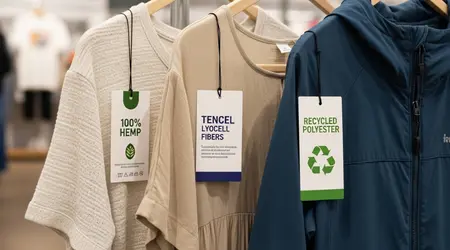
The use of old PET bottles for textiles is often viewed critically today, as it disrupts the recycling cycle of beverage packaging instead of closing its own textile cycles.
A real step forward within the Material Hype 2026 This would involve switching to genuine textile-to-textile recycling, which yields new high-quality fibers from old T-shirts.
However, polyester remains difficult to replace due to its functionality and tear resistance, especially in performance clothing, where natural fibers often reach their mechanical limits.
An important aspect here is the microplastic problem, which must be significantly reduced through special washing bags or innovative coatings on new recycled materials.
See also: Fair fashion for pregnant women: Sustainable throughout pregnancy
Why does bottle recycling harm the circular economy?
When we turn plastic bottles into clothing, we remove them from a perfectly functioning cycle and send them to a final destination that usually ends up in the trash.
The Material Hype 2026 Therefore, it rightly calls for solutions that feed textile waste directly back into fiber production in order to achieve true circularity.
According to a Study by the Ellen MacArthur Foundation Less than 1 % of the textiles produced worldwide are actually recycled into new clothing.
This alarming statistic clearly shows that, despite all the advertising promises, we are still at the beginning of a real transformation of the global textile industry.
See more: Sustainable swimwear: Swimming in an environmentally friendly way
What dangers does microplastic pose despite recycling?
Even recycled polyester loses thousands of tiny fibers with every wash, which enter our oceans unfiltered and massively damage the food chain there.
Anyone involved in the Material Hype 2026 Those who rely on synthetic fibers must be aware of the responsibility to supplement the care of these garments with special filters.
My analysis of current research shows that while innovative weaving techniques reduce the shedding of these microfibers, they do not solve the fundamental problem of synthetic fibers.
Do we really want to wear clothes that are basically just Beautifully packaged trash with a limited shelf life is, instead of relying on natural alternatives?
How do you choose the best material for your wardrobe?
The choice of material should always be based on the intended use, with hemp being the preferred choice for everyday clothing and Tencel for fine textiles.
Within the Material Hype 2026 We are seeing a return to quality, where the longevity of a fabric becomes more important than the pure trend factor.
Imagine buying a pair of jeans that not only lasts two years, but, thanks to the robustness of hemp, lasts for an entire decade.
This longevity is the most powerful weapon against overconsumption and forms the emotional heart of a truly sustainable and responsible wardrobe.
How can you recognize genuine sustainability when making a purchase?
Look for certifications such as the Global Organic Textile Standard (GOTS) or the Cradle-to-Cradle seal, which evaluate the entire production process beyond just the fiber type.
A product in Material Hype 2026 It is only valuable if the people in the factory are paid fairly and social standards are met.
Example: A jacket made from hemp that has been dyed with plant dyes beats any recycled jacket in terms of environmental impact, as it is fully compostable at the end of its life cycle.
Another example is the „Digital Product Passport“ (DPP), which by 2026 will make almost all information on origin and composition immediately transparent via scan.
Why is price alone no longer an indicator?
Expensive designer brands often use the same low-quality synthetic blends as fast-fashion giants, only with a higher markup for the prestige and the shiny logo.
True excellence in Material Hype 2026 You can often find this with smaller pioneering labels that invest their entire budget in researching and sourcing innovative, sustainable fibers.
I recommend that you check the feel of a fabric and critically examine the material composition on the label before making an investment.
High-quality natural fibers not only feel better on the skin, but often improve their comfort even with frequent washing and wearing.
Material comparison 2026: Sustainability & Performance
| material | Water consumption | Pesticide use | longevity | Circulatory potential |
| Nuthanum | Very low | Almost zero | Extremely high | Compostable |
| Tencel (Lyocell) | Small amount | Low (Forest) | High | Partially compostable |
| Recycled polyester | Low (Secondary) | Variable | High | Mechanical/chemical only |
| organic cotton | Medium to High | Zero | Medium | Compostable |
| Conventional cotton | Very high | Extremely high | Medium | Restricted |
The current view of the textile industry shows that hemp and Tencel are the clear winners when it comes to a holistic ecological balance.
While recycled polyester remains a transitional solution for specific niches, the future lies in regenerative natural fibers that nourish the soil instead of poisoning it.
We must understand that every garment is an investment in the environment, the interest from which we receive either in the form of clean water or in the form of microplastics.
By consciously avoiding inferior blended fabrics and focusing on pure, recyclable materials, we create a wardrobe that is morally and aesthetically sustainable.
Ultimately, by 2026, fashion will no longer be a disposable product, but an expression of our deepest values and our technological intelligence.
Which of these materials has impressed you most in terms of comfort, or are you currently planning your first switch to hemp textiles? Share your experience in the comments!
Frequently Asked Questions
Isn't hemp clothing too scratchy on the skin?
No, modern processing methods in 2026 will make hemp fabrics as soft as linen or even silk, while retaining their enormous tear resistance.
Why is clothing made from Tencel often more expensive than cotton?
The production process takes place in a technically sophisticated, closed-loop system that requires high investments, but in return massively protects the environment.
Can recycled polyester be recycled an infinite number of times?
Unfortunately not yet; with every mechanical recycling process, the fibers shorten, so new plastic fibers usually have to be added to ensure stability.
What is the best choice for allergy sufferers in 2026?
Hemp and Tencel are ideal here because they are hypoallergenic and produced without the chemical residues that often cause skin irritation in conventional clothing.
Will organic cotton soon be completely replaced by hemp?
Probably not completely, but hemp will gain a significantly larger market share due to its better climate footprint, in order to reduce water stress in growing regions.