
Fair Fashion for Men 2026: Why the Market Is Still Lagging Behind

Advertisement
Fair Fashion for Men 2026 Today it is more than a niche topic, but the industry continues to struggle with structural deficiencies in selection and availability.
While women's fashion is flooded with sustainable innovations, the shelves for men often look like an endless repetition of simple grey organic cotton shirts.
Many fashion-conscious men search in vain for bold cuts or technical innovations that combine ecological responsibility and modern style.
This imbalance in the product range is slowing down the enormous market potential, as the demand for ethical clothing is growing faster than the actual supply from designers.
Focus of the analysis
- Market situation: Why the supply for men is stagnating quantitatively.
- Psychology: The influence of traditional consumption patterns on sustainable design.
- Solutions: Strategies for a diverse and fair men's wardrobe.
Why is the range of fair trade men's fashion growing so slowly?
A look at current market data reveals a clear discrepancy between genders in the implementation of sustainable concepts.
The Fair Fashion for Men 2026 According to current estimates from the portal, this makes Statista only about 25% of the entire sustainable clothing market.
This reluctance on the part of labels is often due to the assumption that men are less willing to experiment with materials and colors.
Designers prefer to invest their budget in women's fashion, as the rate of trend changes and the general purchase frequency have historically been higher in this sector.
What role does the design deficit play?
Fair fashion for men is often limited to basics such as socks, underwear and simple T-shirts without any fashionable aspirations.
Those looking for a sustainable blazer or unusual streetwear often have to spend hours scouring specialized online shops, as brick-and-mortar stores hardly serve these niches.
This one-sidedness leads to men often associating the field of fair fashion with an "eco-look" that does not fit their professional everyday life.
When aesthetics are subordinated to ethics, the product loses its connection to the mass market and remains a niche phenomenon for idealists.
++ Why repairability will be more important than biomaterials in 2026
How do supply chains hinder innovation?
Sourcing certified fabrics specifically suited to masculine cuts and stresses is often difficult and expensive.
Many producers focus on large quantities of women's fashion, which drives the minimum order quantities for special men's collections to utopian levels.
Small brands can rarely bear this financial risk and therefore stick to tried and tested standard models to avoid losses.
This creates a vicious cycle of manufacturers' lack of courage and the resulting reluctance of disappointed male customers to buy.
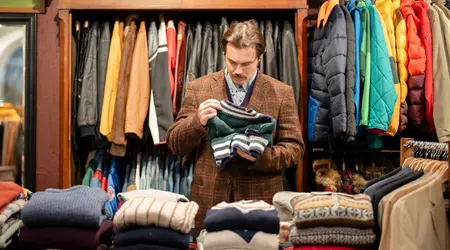
What psychological hurdles prevent a breakthrough?
Men often consume fashion in a more functional way and buy less frequently, which reduces the visibility of trends in the field. Fair Fashion for Men 2026 more difficult.
An analogy illustrates this: Men's fashion is like a heavy freight train that takes a long time to pick up speed on a sustainable track.
In contrast, women's fashion is like an agile express train that constantly tries out new directions and reacts immediately to social changes.
As long as the industry believes that men only replace clothing when absolutely necessary, the incentive for innovative eco-collections remains very low.
See also: Fair fashion for pregnant women: Sustainable throughout pregnancy
Is the image of sustainability too feminine?
In advertising, fair fashion is often promoted with softness, natural tones and a gentle aesthetic that does not appeal to many men.
The need for robustness, technical perfection, or an urban status symbol is currently only very inadequately met by sustainable brands.
If ecological facts such as water consumption or CO2 balance are not linked with masculine functionality, the message does not reach the target group effectively enough.
This creates a communication gap that many conventional brands are unfortunately much more adept at filling through greenwashing campaigns than true pioneers.
See more: Sustainable swimwear: Swimming in an environmentally friendly way
Why is there a lack of social pressure on men?
While the discourse on fast fashion and working conditions is omnipresent for women, men's fashion is often still treated as a neutral consumer good.
Don't we all ask ourselves: Why should a shirt be any less moral just because it isn't a trendy item?
This lack of interest in origin means that the pressure on large chains to radically redesign their men's departments is weaker.
Without a critical mass of male consumers who loudly demand transparency, change in the executive suites of fashion companies unfortunately remains elusive.
How can brands close the gap in 2026?
To unlock the full potential of Fair Fashion for Men 2026 To fully exploit this potential, labels must finally focus on radical transparency and technological innovation.
Examples such as water-repellent jackets made from recycled ocean plastic show that sustainability and functionality can form an extremely strong symbiosis.
By demonstrating that fair production does not mean sacrifice, but rather an increase in quality, brands gain the trust of a purchasing power and loyal target group.
The goal is to create clothing that lasts a lifetime while simultaneously telling a story of global justice.
What opportunities does the technology offer?
New recycling processes now make it possible to transform old clothes into high-quality fibers that are far superior to conventional polyester in terms of breathability.
Such high-tech solutions are particularly attractive to men because they focus on the performance and durability of the garments.
Furthermore, the digitization of the supply chain makes it possible to retrieve the ecological footprint of each individual garment directly at the point of sale via QR code.
When a man sees that his shirt has saved 2,000 liters of water, sustainability becomes a measurable success.
Why is local craftsmanship the solution?
A return to regional production shortens transport routes and ensures fair wages in Europe, which massively strengthens the credibility of the brands.
A bespoke shirt from a small manufacturer in Portugal offers more exclusivity than anonymous mass-produced goods from the Far East.
Men often appreciate the story behind the product and are willing to pay a fair premium for genuine craftsmanship.
When brands revive this pride in quality, fair fashion transforms from a "necessary evil" into a coveted lifestyle statement for the modern gentleman.
Market comparison: Conventional vs. Fair Fashion 2026
| criterion | Conventional men's fashion | Fair Fashion for Men 2026 |
| Material origin | Often opaque, high pesticide use | Certified organic fabrics or recycling |
| durability | Planned obsolescence (fast fashion) | Focus on durability and quality |
| Working conditions | Often precarious in low-wage countries | Fair wages and social security |
| Design variety | Extremely high and trend-driven | Currently still limited, focus on classics |
| Price-performance ratio | Cheap to buy, expensive for the environment | Higher purchase price, low life cycle costs |
The development in the area Fair Fashion for Men 2026 This shows that we are only at the beginning of a necessary transformation of the fashion world.
When we stop seeing fashion merely as a consumer good and instead understand it as an investment in our future, everything changes.
The industry needs to have the courage to rethink menswear, moving away from the bland, uniform look and towards ethical excellence and individual style.
Only in this way can we ensure that fair fashion does not remain a privilege, but becomes the standard for every man who cares about the world.
A new awareness of the wardrobe
The future of men's fashion lies in slowing down and returning to true values beyond fast trends.
Every purchase of a Fair Fashion for Men 2026 is a voice for a fairer global economy and against the destruction of our environment.
When we start prioritizing quality over quantity again, we create space for clothing that truly means something.
Let us set the standard together and show that style and conscience don't have to be opposites.
Share your experiences with fair brands in the comments or discuss your favorite sustainable materials with us!
Frequently Asked Questions
Why is fair trade menswear often more expensive than conventional clothing?
Fair labels pay living wages and use high-quality raw materials, which of course significantly increases production costs compared to exploitative fast-fashion models.
Furthermore, they often produce in smaller quantities, which reduces economies of scale.
How can I recognize genuine fair fashion for men?
Look for independent labels such as GOTS (Global Organic Textile Standard), Fair Wear Foundation or the government-backed "Green Button" label.
These guarantee compliance with minimum social and environmental standards throughout the entire production chain.
Is there also sustainable business fashion for men?
Yes, more and more brands are specializing in suits made from organic virgin wool or Tencel shirts, which are easy to iron and breathable.
The market here is growing slowly but steadily, as demand for ethical workwear increases.
Is second-hand fashion a good alternative to fair fashion?
Absolutely, second-hand is the most sustainable form of consumption, as no new resources are used.
It is an excellent way to minimize your own ecological footprint while also finding unique, individual pieces.
How can I best care for fair fashion?
Sustainable fabrics are often more natural and require gentle washing at low temperatures.
Washing less, air drying, and making small repairs will massively extend the lifespan of your clothes and also save valuable energy and water.