
Slow Fashion vs Fast Fashion: Why quality is more important than ever
Advertisement
Slow Fashion vs. Fast Fashion is not just a question of fashion, but an ethical, ecological and economic decision that is more important today than ever.
In times of increasing ecological pressures and growing consumer awareness, the wheat is separated from the chaff.
Brands are under pressure to produce transparently, sustainably, and fairly. In light of new legislative initiatives against excessive textile production, such as in France (Senate passes a law against ultra-fast fashion in 2025) (Reuters) puts quality in the spotlight.
This article examines why today Slow Fashion vs. Fast Fashion is no longer a theoretical debate, but has practical consequences for consumers, producers and the environment.
I analyze, provide data, illustrate with examples, and at the end I ask you: Which side do you choose?
Why quality is central today
Instead of constantly chasing new trends, quality speaks on three fronts: durability, repairability and resource consumption.
Good materials wear out more slowly, and finishes such as reinforced seams or concealed seams increase robustness. A study shows that upcycling and long-lasting clothing are popular with consumers over 80 (ECOSKILLS).
Defective fast fashion items end up in the trash early. In the EU alone, 4–9% of newly produced textiles are destroyed before they are even sold (European Parliament). In contrast, slow fashion calls for avoiding such waste.
++ Fair working conditions in the fashion industry: Why they are so important
Quality also means reduced replacement costs and lower energy costs for production and logistics along the entire supply chain. This approach shifts the price-value ratio from a cheap product to an investment.
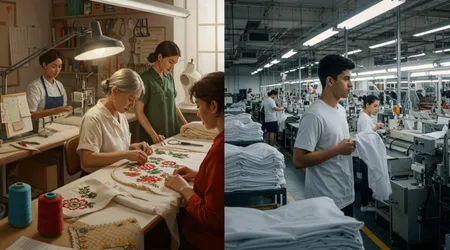
Features in comparison: Slow Fashion vs. Fast Fashion
Production pace & collections
Fast fashion constantly polishes new collections (up to 52 micro-collections annually). Brands react to trends within weeks.
Slow fashion, on the other hand, plans for the long term, with seasonless, timeless pieces. This difference in pace marks the core of the debate. Slow Fashion vs. Fast Fashion.
See also: The best online shops for sustainable fashion
Materials & Supply Chain
Fast fashion uses cheap synthetic fibers, chemical dyes, and long transport routes. The textile industry causes 20% of global water pollution through dye treatment and microplastic release (European Parliament).
Slow fashion relies on organic fibers (organic cotton, linen, Tencel) and more regional supply chains, often with traceable certificates (GOTS, OEKO-TEX).
Transparency & Ethics
Many fast fashion brands operate in opaque factories, face wage dumping, and questionable working conditions. Slow fashion brands publish supply chains, audits, and fair wages.
Consumer press reports increasingly highlight scandals in fast fashion; some countries are responding with regulations. In France, for example, advertising for ultra-fast fashion is being restricted. (Reuters).
See more: Sustainable Shoes: 10 Brands You'll Love
Waste & Recycling
Fast fashion operates a “take-make-dispose” model: 92 million tons of textile waste are generated worldwide every year (Carbon Trail).
Only just under 1% of this clothing enters closed recycling cycles (European ParliamentSlow fashion promotes repair, second-hand, upcycling, and circular business models.
Table: Comparison of selected features
| feature | Fast Fashion | Slow Fashion |
|---|---|---|
| Production speed | very high, micro-collections | controlled, limited, timeless |
| Material selection | often synthetic, not very sustainable | natural, certified fibers |
| Transparency & working conditions | often non-transparent, risky | open, fair, auditable |
| Waste production & recycling | extremely high, low recycling rate | less waste, promoting circulation |
| Price structure | low purchase price | higher at purchase, lower over lifetime |
| Consumer awareness & demand | Trend-driven, impulsive | needs-oriented, conscious |
Current market development & growth
The market for sustainable clothing is expected to GMI Insights from USD 3.6 billion (2024) to approximately USD 9.4 billion by 2034 (CAGR ~10.3% yoy). (Global Market Insights Inc.) In Germany, manufacturers report that 69% of consumers consider environmental and social compatibility when making purchases. (Global Market Insights Inc.)
Interestingly, fast fashion remains big, but the growth of sustainable brands exceeds that of the conventional segment, according to Roundup data. (The Roundup) This means that demand is shifting and quality is becoming the distinguishing feature.
Why slow fashion seems important today
Resource scarcity & climate pressure
With increasing pressure on water resources, soil quality and carbon budgets, waste is no longer sustainable.
The textile industry has a responsibility to optimize resource efficiency. The EU is tightening regulations on textile collection (mandatory from 2025) and take-back responsibility (European Parliament).
Consumer expectations & ethics
Consumers demand authenticity. A survey by Zalando/GlobeScan found that 74% of consumers are trying to consume more sustainably, but 41% find sustainable products too expensive and 27% find them difficult to identify.
(The Guardian) Slow fashion answers this gap when brands are credible, transparent and accessible.
Long-term profitability
Repairing a good piece of clothing or wearing it for years pays for itself compared to repeatedly buying new ones.
Quality is therefore an economic strategy. Brands that deliver durable clothing reduce returns, waste, and reputational risks.
Practical examples
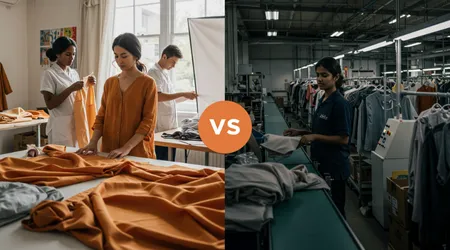
Example 1: German small brand
A Berlin-based designer produces limited-edition collections with certified organic cotton, fair manufacturing, and a transparent online dashboard.
Your customers will not only receive fashion, but also insight into every step of production. This is how the difference becomes apparent. Slow Fashion vs. Fast Fashion in everyday experience.
Example 2: Upcycling DIY Community
In a small town, an initiative organizes sewing workshops: residents bring old clothes and learn how to repair or redesign them.
Bags or patchwork are made from broken jeans. Slow Fashion vs. Fast Fashion tangible consumers become producers.
Advantages and limitations in everyday life
The Advantage The benefits of slow fashion lie in lower environmental impact, higher quality, ethical behavior, and longer usefulness. Disadvantage: some pieces are difficult to obtain, have a higher entry price, and smaller quantities can make logistics more expensive.
But these boundaries are increasingly disappearing with new platforms, mesh supply chains, digital order forecasting tools, and legislation that limits fast fashion.
AI-driven prediction of fashion sales (e.g. using diffusion models) can reduce overproduction (arXiv).
Analogy: The long-lived beech instead of the fast-growing grass
Imagine two plants: One type of grass grows quickly, is mowed frequently, and fades quickly. The other is a beech tree, which grows slowly but lasts for decades.
Fast fashion is like grass—quick, abundant, and short-lived. Slow fashion is like beech trees: it invests time, offering long-term shade, utility, and beauty.
A new H2: Legislation & policy development
In June 2025, the French Senate approved a legislative package regulating the advertising and import of ultra-fast fashion (fines of up to €10 per garment).
(Reuters) This signal influences brands across Europe: quality, traceability and environmental protection must be more closely monitored.
At EU level, new regulations are also pushing for circular textiles and separate collection systems by 2025.
(European Parliament) Fashion companies must focus on longer product life cycles, which reinforces the advantage of Slow Fashion vs. Fast Fashion in practical politics.
Final remarks
In the debate Slow Fashion vs. Fast Fashion Today, quality is in focus as an ethical, ecological and economic necessity.
Those who buy cheaply pay multiple costs later: through waste, resource consumption, reputational damage, or replacement purchases. Brands and consumers alike are at a tipping point.
Do you choose to follow the blueprints of green fashion, or remain trapped in the vicious cycle of mass production? The decision isn't easy, but it's real. Will you shop consciously or consume conveniently?
Frequently Asked Questions (FAQs)
Q1: Is slow fashion only for the upper class?
Not necessarily. Many brands offer modular, durable pieces or rental/exchange models as an entry point, making sustainable fashion increasingly accessible.
Q2: Do certified materials use fewer resources?
Yes, organic cotton, for example, uses significantly fewer pesticides and water. Furthermore, better processing and quality controls produce less waste.
Q3: How do I recognize real slow fashion?
Pay attention to a transparent supply chain, small quantities, repairability, clear certifications and durable designs, not to marketing platitudes.
Q4: Is upcycling worth it compared to buying new?
Absolute upcycling extends the life cycle, saves energy, and reduces waste. It's an active contribution to the circular economy.
Q5: When will fast fashion be curbed through regulation?
Legislative initiatives like the one in France in 2025 will create pressure. But consumer decisions will be the driving force.